
Built to CE, UL or CSA standards
High-accuracy crankshaft balancers for passenger vehicles, trucks, off-highway, marine and small engines, from aftermarket rebuilds to OEM lines. Horizontal single-station or two-station machines, measure-only or with manual or automatic drilling, each specified around your crankshaft drawing. Manual and automatic options, backed by up to a 3-year warranty.
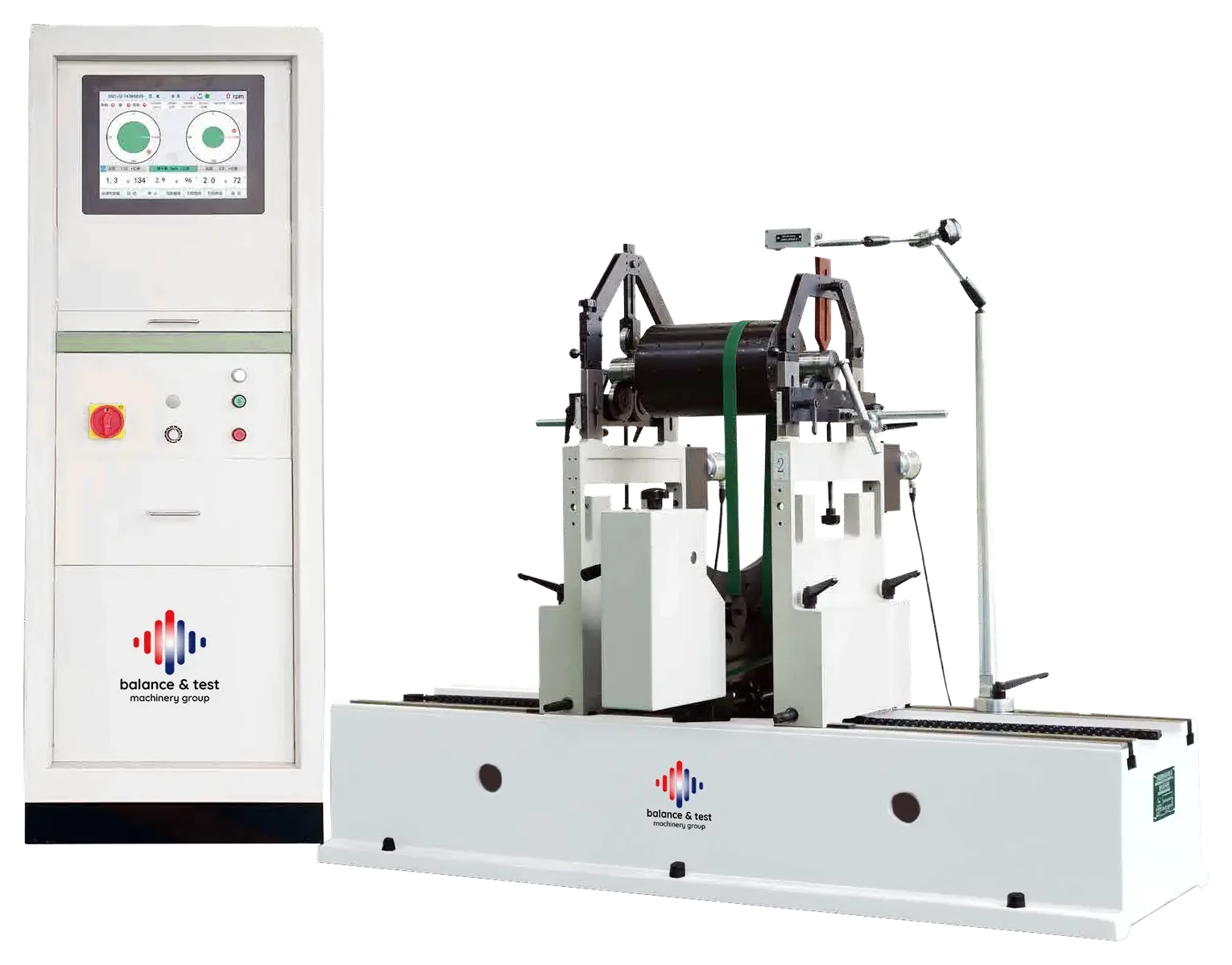
Overview
Built for the crankshaft.
Crankshaft balancers are horizontal machines, available in single-station or two-station formats depending on production volume. The crank runs on its main journals; the most flexible configuration is a belt drive, used for smaller cranks and mixed work, while heavier and high-volume crankshafts are usually driven from the flange or nose on an end-drive machine.
Balancing correction options range from measure-only machines to systems equipped with manual or automatic drilling stations. For high-volume production, machines can be supplied with integrated MQL (minimum quantity lubrication) drilling units, ensuring fast cycle times and consistent results.
Levels of automation are tailored to the customer. Aftermarket and repair shops typically use manual machines with optional drilling capability, while OEM and high-volume production facilities rely on automatic single-station systems for heavy-duty cranks, or two-station layouts with rotary lift-and-lower systems — one station for measurement, the second for correction.
Tooling is equally versatile. Inline and flat-plane crankshafts need no bob weights. Cross-plane V6 and V8 crankshafts are balanced with bob weights clamped to the crank pins to represent the rotating and reciprocating mass of the rods and pistons. On production machines the counterbalance is built into the workholding instead, which removes the bob weights and cuts setup time.
Applications
Where it works.
Key features
Accurate. Robust. Simple.
Every machine is proved to ISO 21940-21 before it ships.
Engineered for continuous industrial use
Easy setup, fast changeover.
Industry leading on new machines.
Measuring system
Measure, correct, certify.
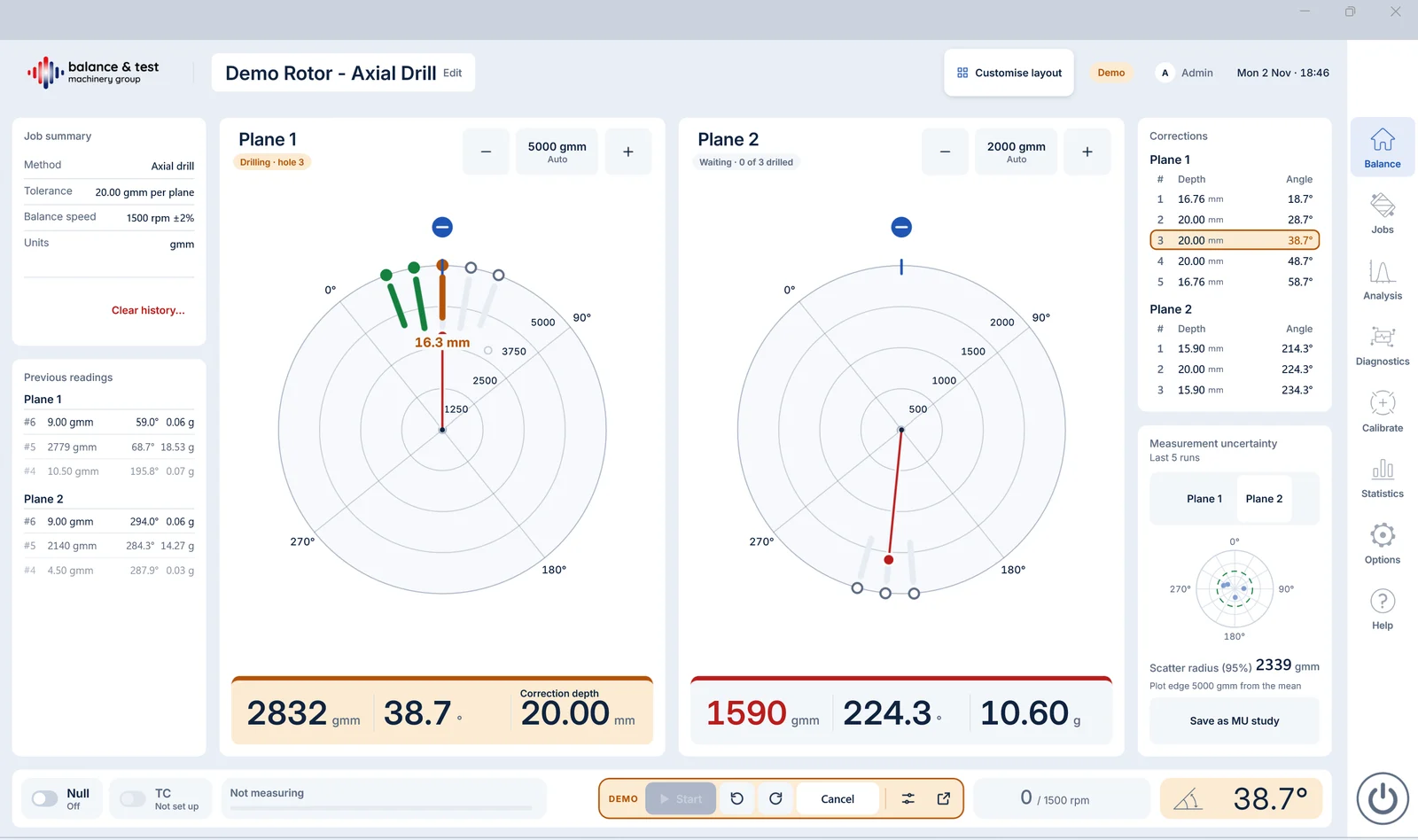
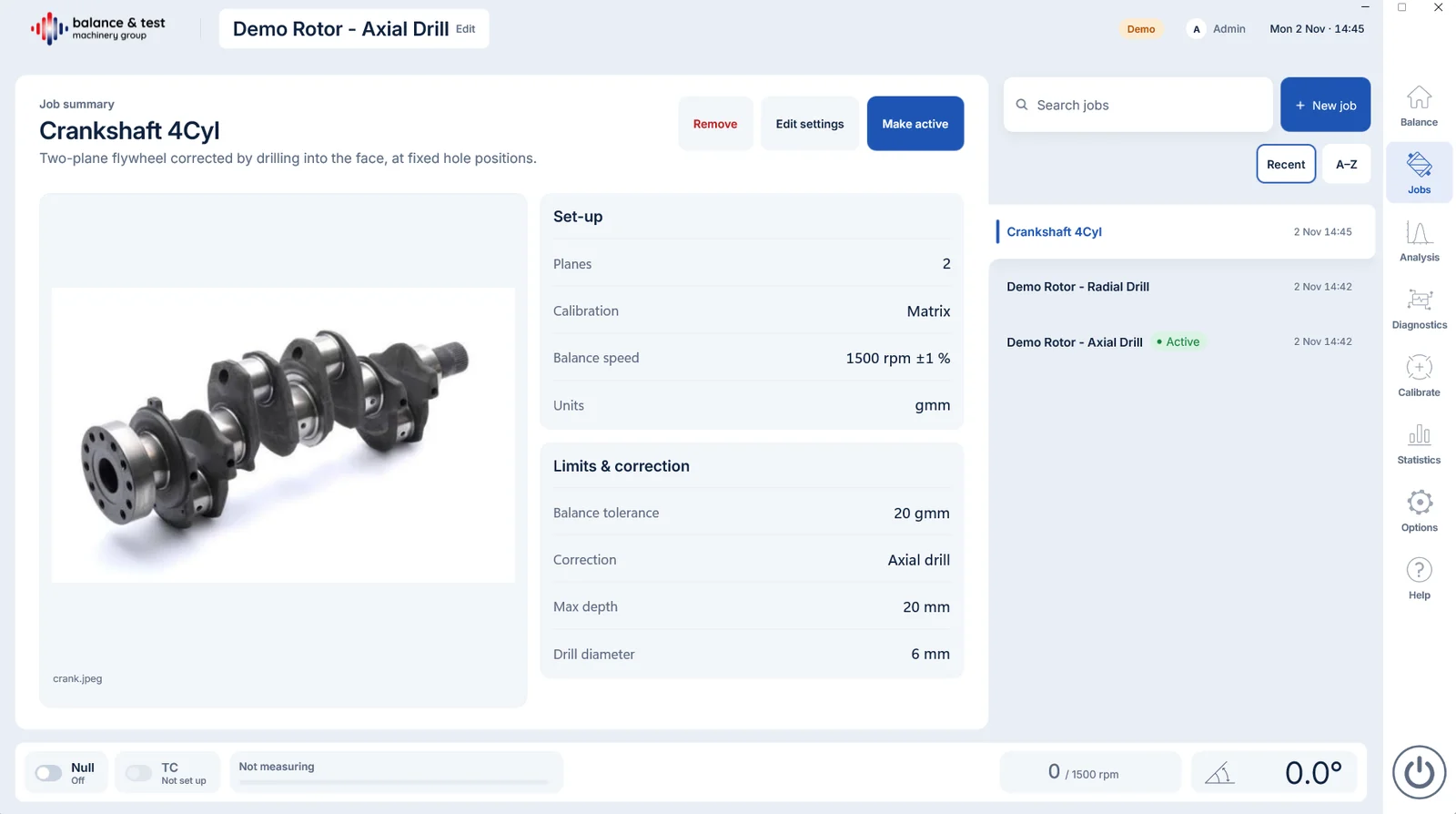
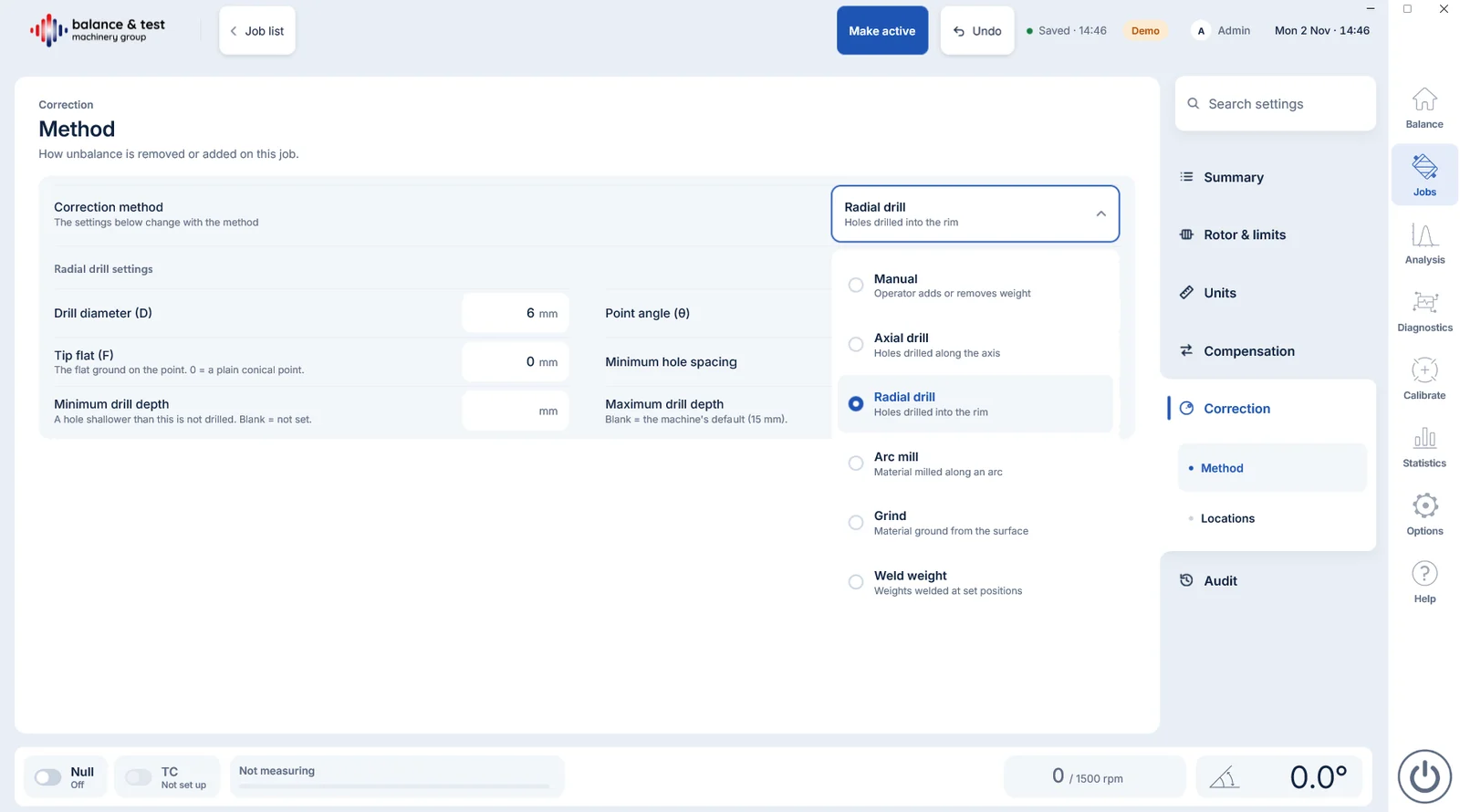
Our fifth-generation measuring system: dedicated electronics that measure unbalance with extreme accuracy, connected over Ethernet to the UltraX balancing software.
01 / 06
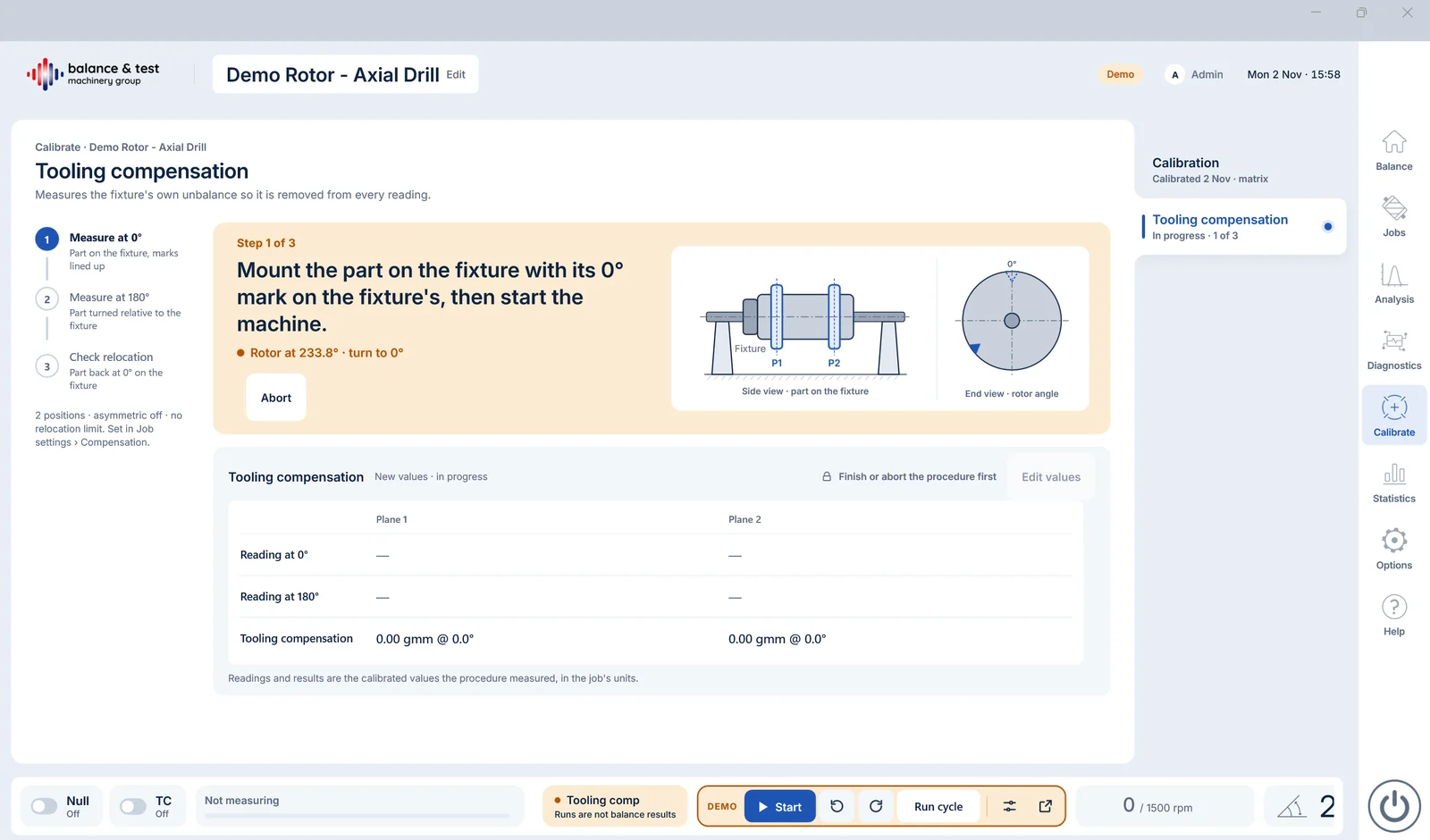
Each correction plane has its own polar display, with the unbalance amount, angle and correction in large, easy-to-read figures. During correction, every hole appears with its depth and angle and turns green once drilled.
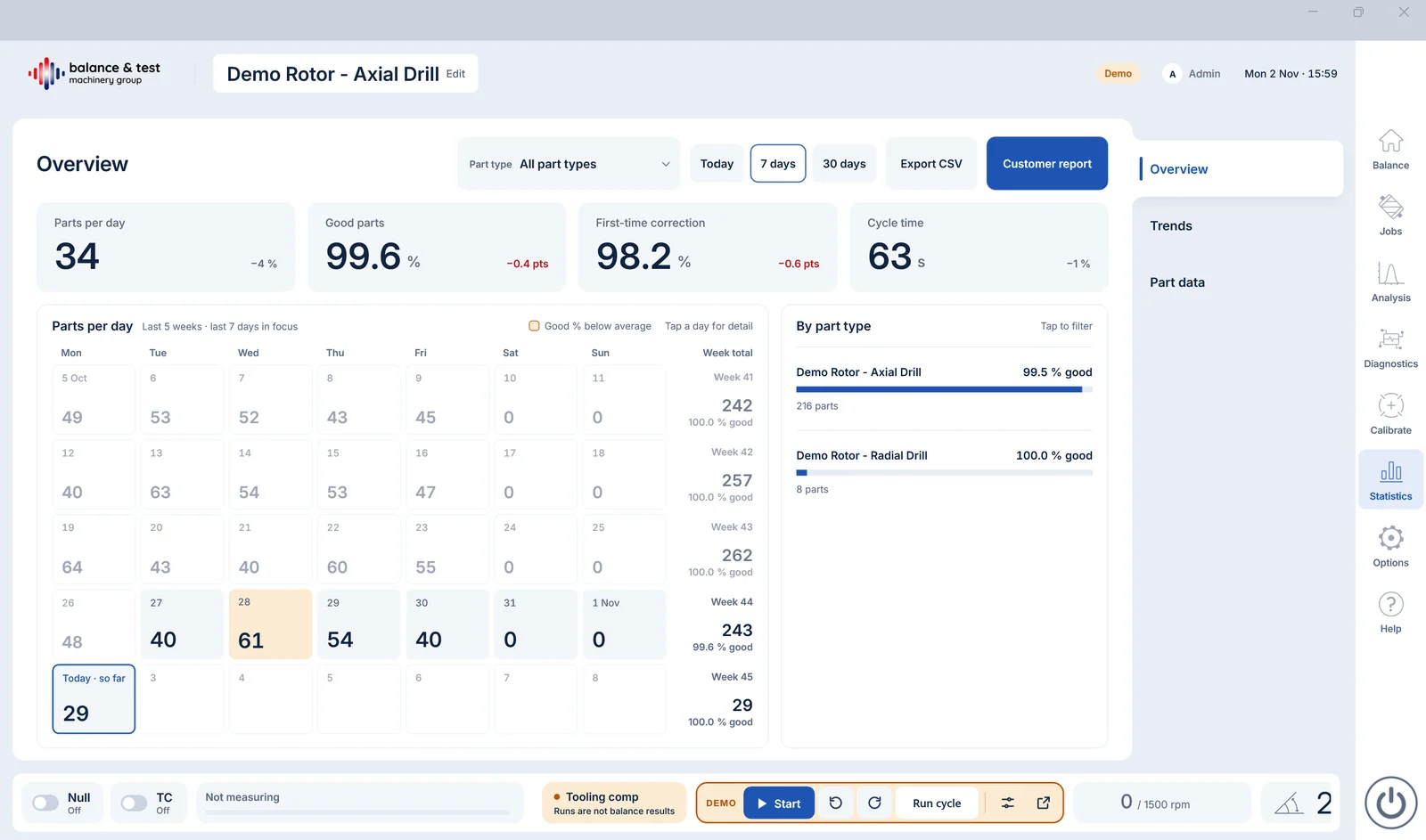
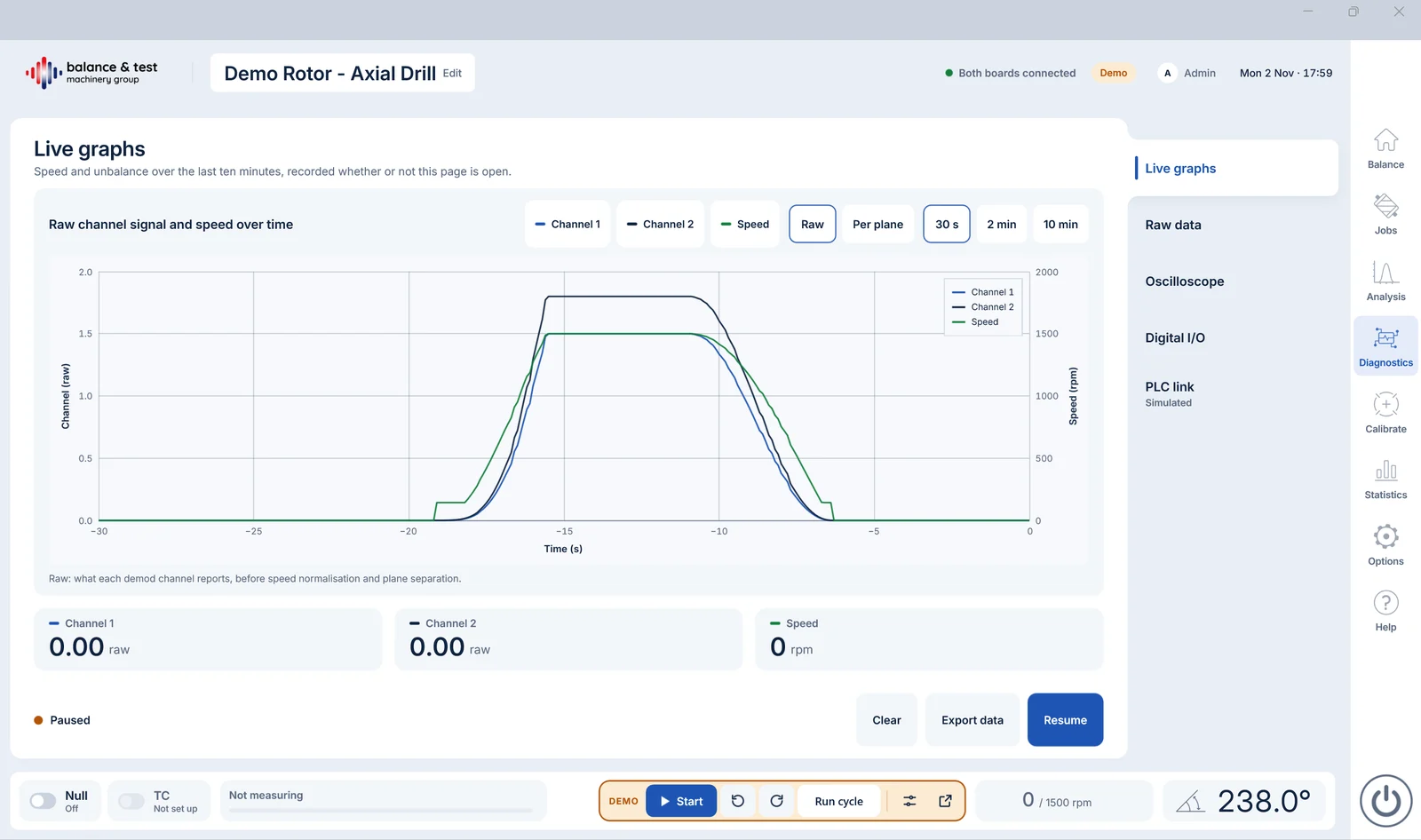
The real UltraX software balancing a demo rotor: measure, drill, re-measure.
Specifications
Send us the drawing.
Crankshaft balancing machines are designed for the particular part, so there is no standard specification table. Send us the drawing, weights and the tolerance you work to, and we will specify the machine.
Why Balance & Test
Service that delivers.
Industry leading on new machines.
Installation and operator training included as standard.
Plus local service teams.
Head office and service center in Bristol, UK; service and support in Ann Arbor, Michigan; engineering, manufacturing and support in Spain; sales and support in Germany.
Balancing machines and all our equipment are built to CE, UL or CSA standards, to suit your market.
We service and calibrate balancing machines from any manufacturer.
FAQ
All crankshaft balancers are built to CE, UL or CSA standards to suit your market, and every machine is proved to ISO 21940-21 before shipment.
Cross-plane V6 and V8 crankshafts are balanced with bob weights clamped to the crank pins, to represent the rotating and reciprocating mass of the rods and pistons. Inline and flat-plane crankshafts need no bob weights. On production machines the counterbalance is built into the workholding instead, which removes the bob weights and cuts setup time.
Crankshaft balancing machines are designed for the particular part, so there is no standard specification table. Send us the drawing, weights and the tolerance you work to, and we will specify the machine. Smaller cranks and mixed work usually suit a belt drive, while heavier and high-volume crankshafts are driven from the flange or nose on an end-drive machine.
Yes. Aftermarket and repair shops typically use manual machines with optional drilling capability. OEM and high-volume production facilities use automatic single-station systems for heavy-duty cranks, or two-station layouts with rotary lift-and-lower systems: one station for measurement, the second for correction. High-volume machines can have integrated MQL drilling units for fast cycle times.
Related machines
Also worth a look.
Balancing
For light & heavy-duty vehicles and industrial…
View driveshaft balancersBalancing
High accuracy flywheel balancing machines with optional integrated manual or automatic correction. Engineered for robustness, backed by a…
View flywheel balancersGuide
Measure, press, re-measure: how shafts are made straight.
Read the guideIndustry
Balancing, straightening and test stands for driveshafts, axles, crankshafts and EV rotors.
See automotiveReady to balance better?
We’ll configure the right crankshaft balancing machine for your technical needs and budget.