
Built to CE, UL or CSA standards
High-accuracy horizontal balancing machines for every rotor type, from small components to large industrial shafts and rotors up to 10,000kg / 22,000lbs. Choose belt drive, end drive or dual drive, with manual and automatic options from measure-only to robotic loading. Every machine is proved to ISO 21940-21 before shipment, backed by up to a 3-year warranty.
Overview
Built for the rotor.
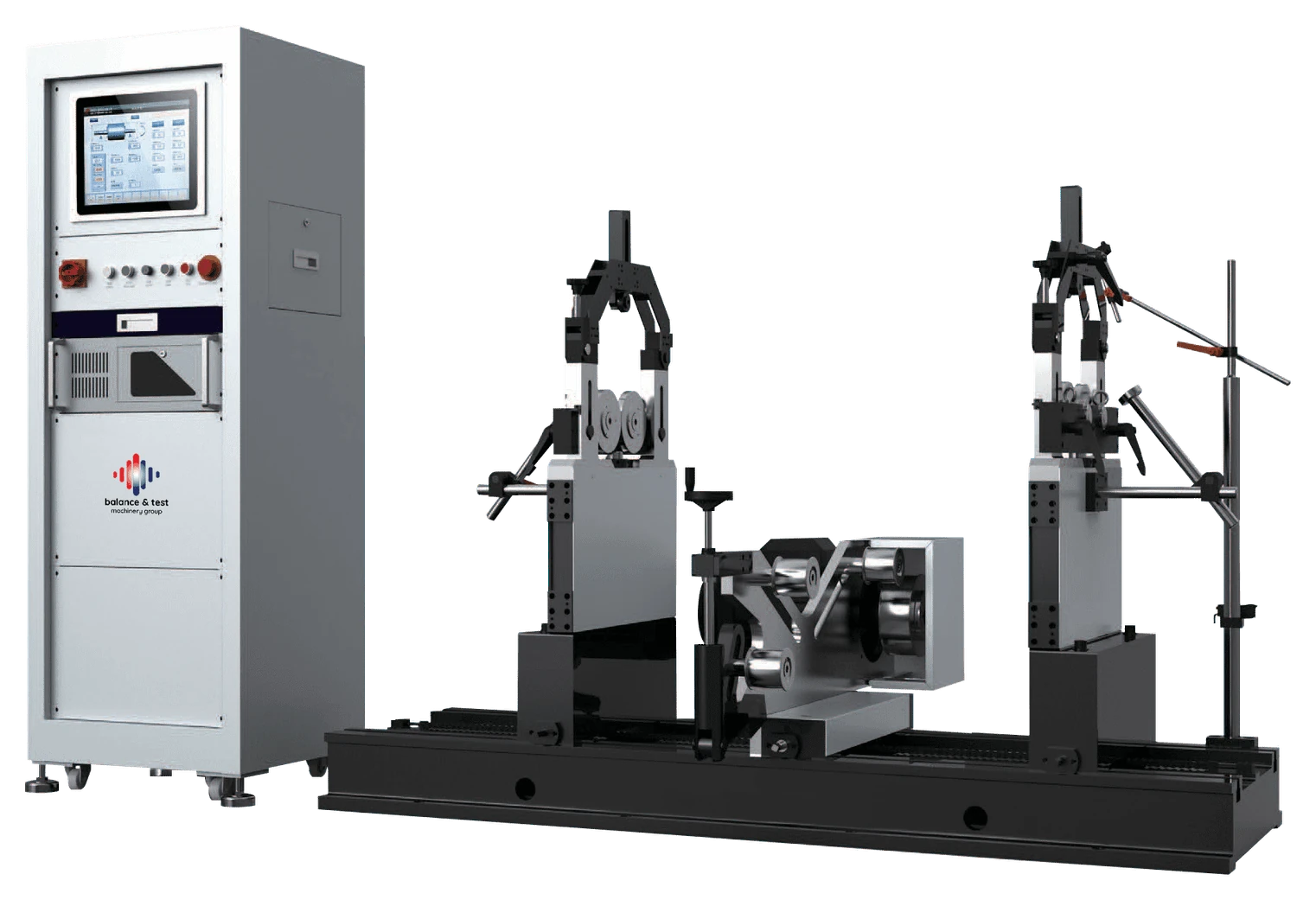
Our horizontal balancing machines come in a range of sizes for rotors of many lengths and diameters, from small components to large industrial shafts. The rotor runs on its own journals on roller supports, driven by a belt over its body, by an end drive through a cardan shaft, or by either on a dual-drive machine. Support height and position are fully adjustable for a wide variety of part geometries. All machines are supplied with comprehensive safety guarding, or can be integrated into a production cell safety system.
Machines can be measure-only or fitted with manual correction such as drills, and upgraded with robotic or gantry loading to increase throughput and reduce handling. Semi-automatic systems can be fitted with integrated drills, welders or other correction tools, depending on production needs.
Tooling is designed for flexibility. End-drive machines use adaptors to connect the rotor to the drive shaft, while components without their own journals are mounted on mandrels or arbors made for the part. This lets one horizontal balancer handle many different rotor types.
Applications
Where it works.
Key features
Accurate. Robust. Simple.
Every machine is proved to ISO 21940-21 before it ships.
Engineered for continuous industrial use
Manual and automatic machines available
Industry leading on new machines.
Measuring system
Measure, correct, certify.
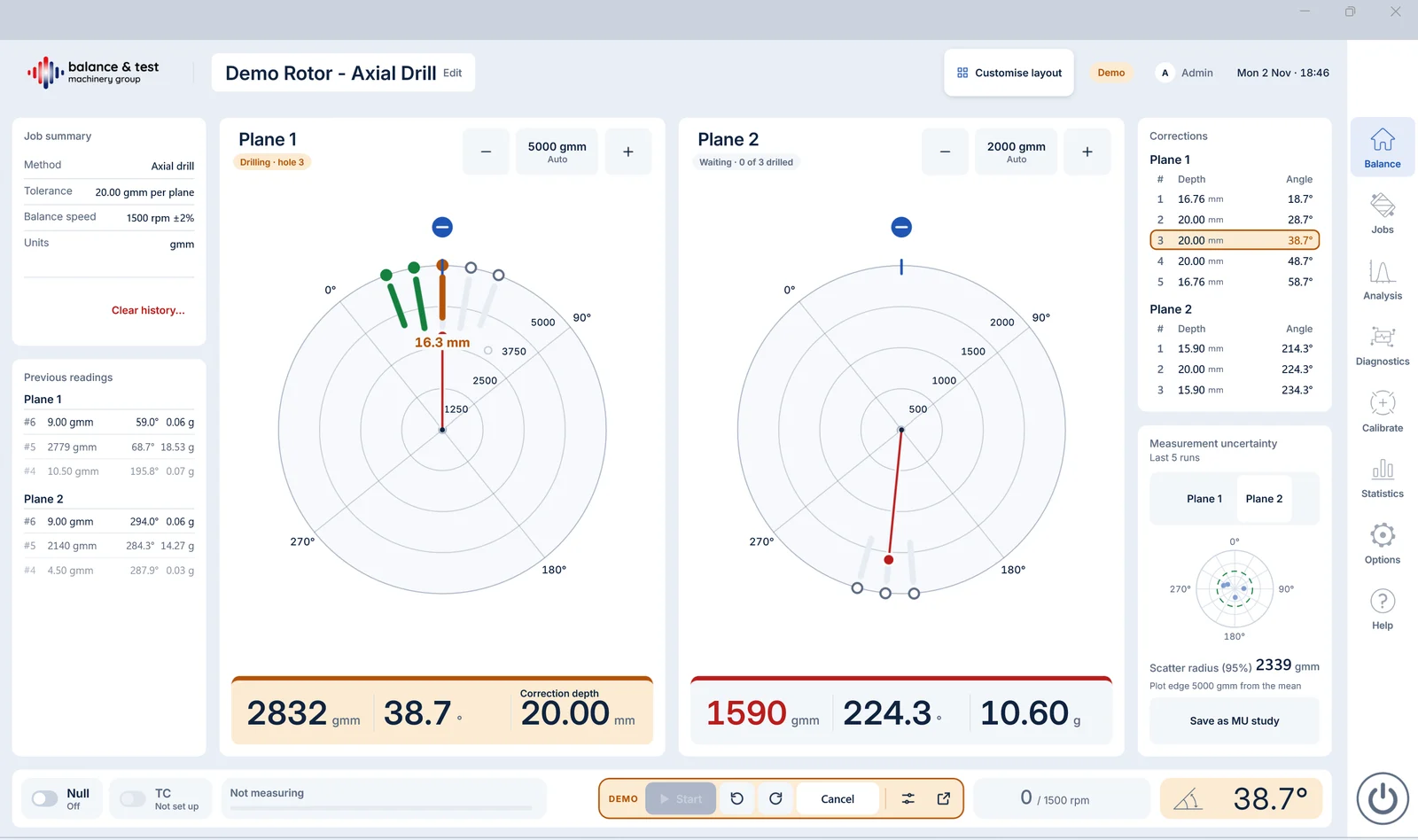
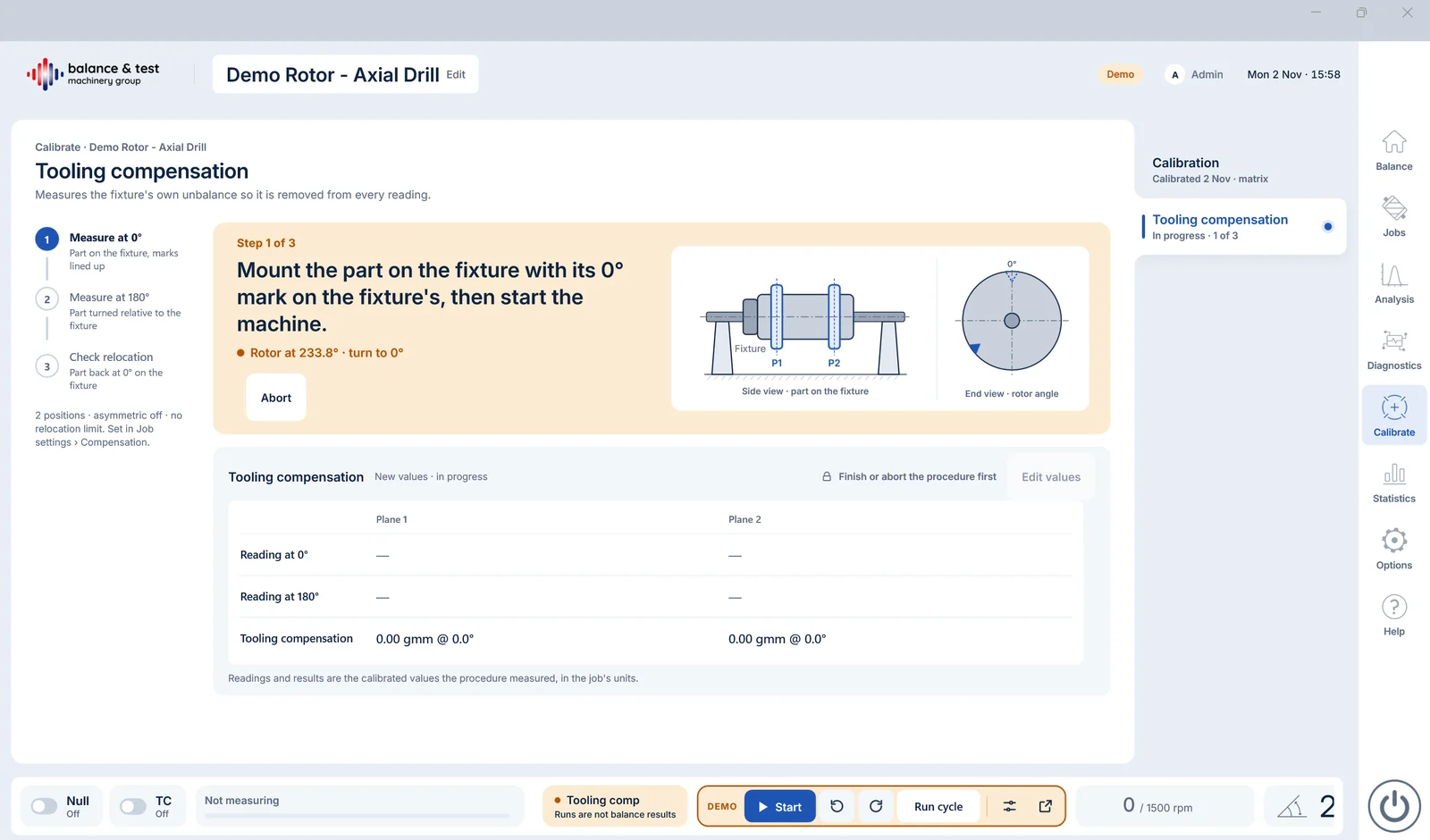
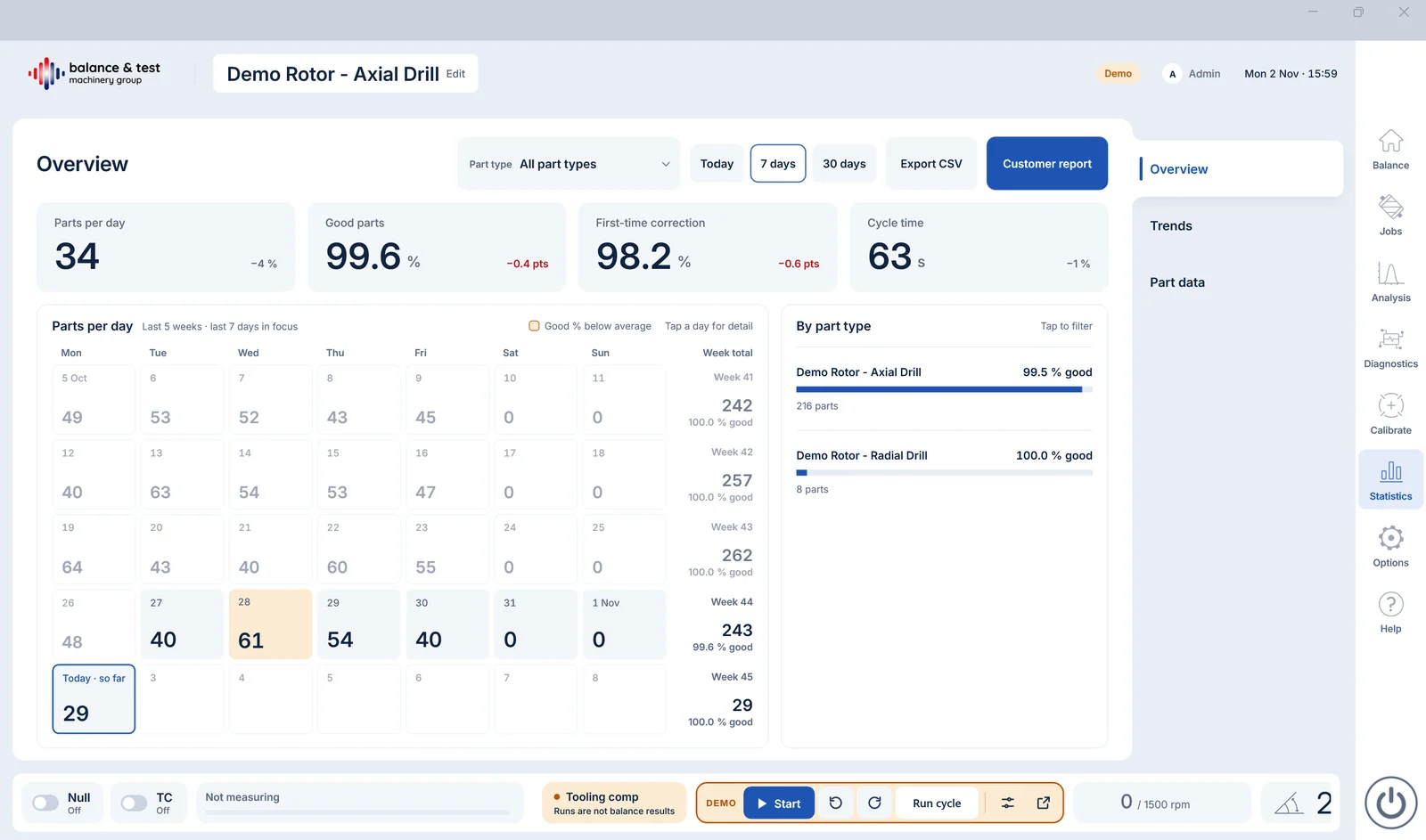
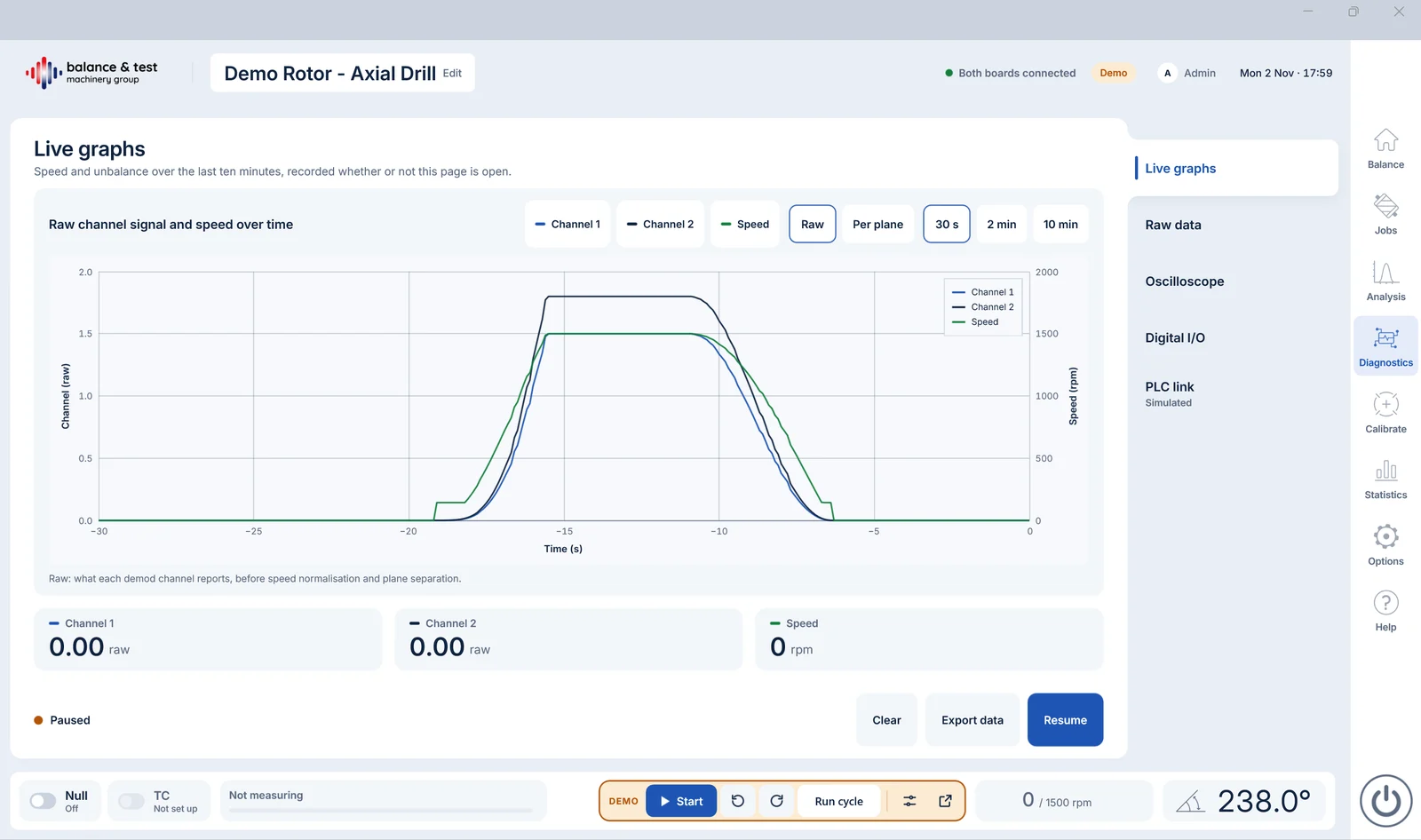
Our fifth-generation measuring system: dedicated electronics that measure unbalance with extreme accuracy, connected over Ethernet to the UltraX balancing software.
01 / 06
Each correction plane has its own polar display, with the unbalance amount, angle and correction in large, easy-to-read figures. During correction, every hole appears with its depth and angle and turns green once drilled.
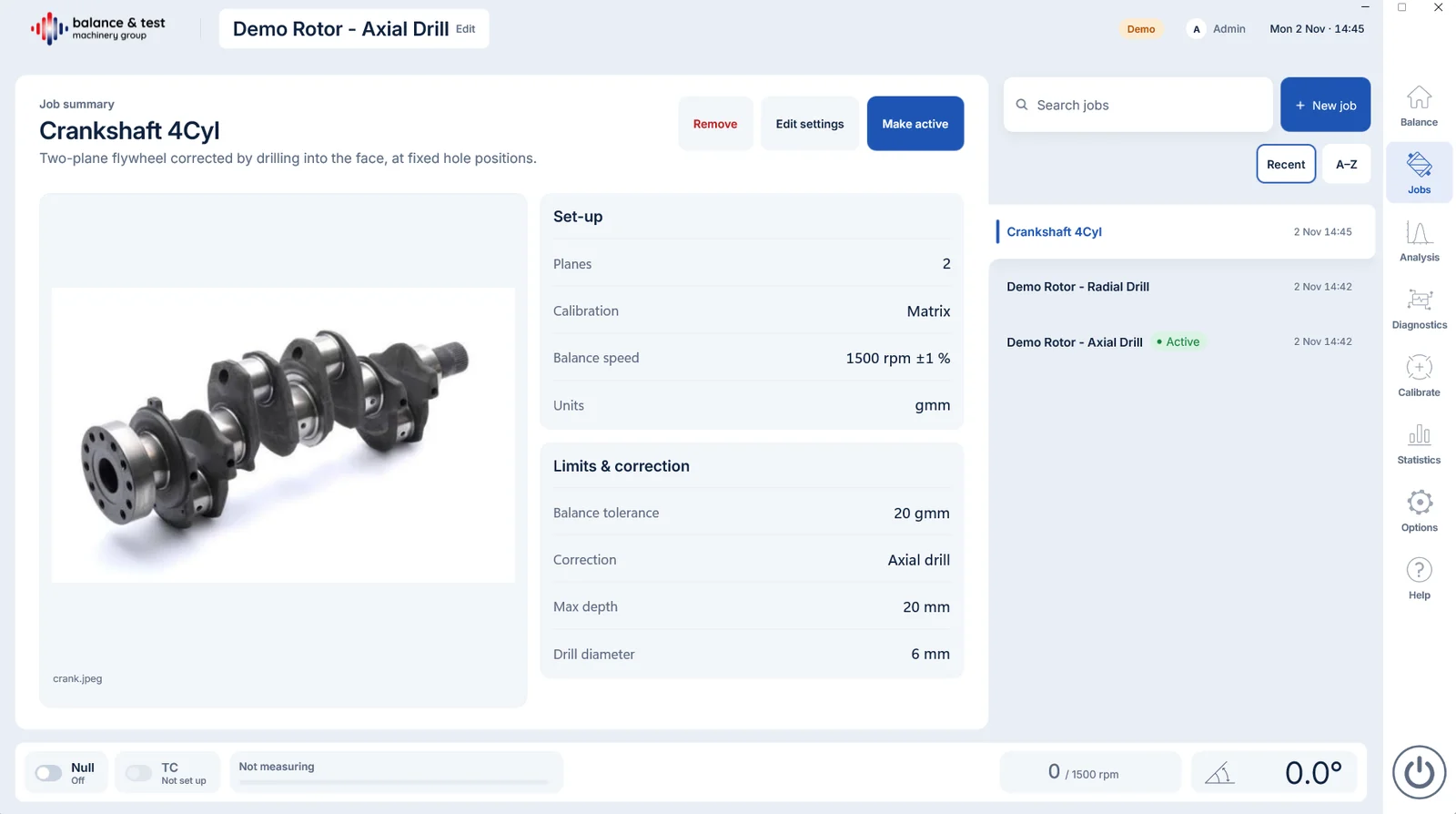
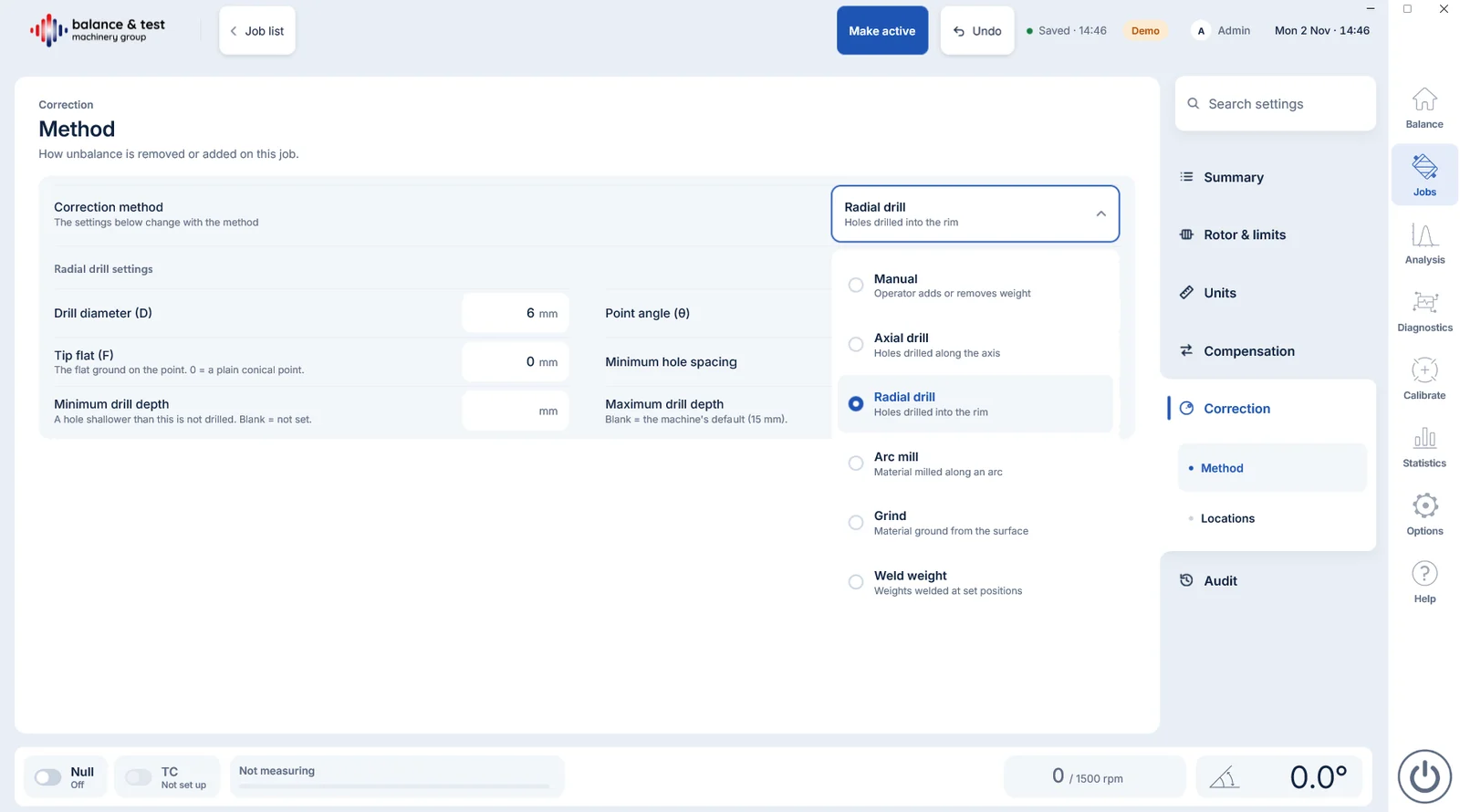
The real UltraX software balancing a demo rotor: measure, drill, re-measure.
Specifications
The numbers.
| Model | H1.6B | H5B | H10B | H16B | H50B | H100B | H160B | H300B | H500B | H1000B | H2000B | H3000B | H5000B | H7500B |
|---|---|---|---|---|---|---|---|---|---|---|---|---|---|---|
| Maximum rotor weight (kg) | 1.6 | 5 | 10 | 16 | 50 | 100 | 160 | 300 | 500 | 1000 | 2000 | 3000 | 5000 | 7500 |
| Maximum rotor diameter (mm) | 260 | 300 | 300 | 360 | 700 | 800 | 1000 | 1200 | 1500 | 1600 | 1600 | 1600 | 2100 | 2100 |
| Rotor journal range (mm) | 3-15 | 3-15 | 5-20 | 5-25 | 6-30 | 8-50 | 9-70 | 10-70 | 10-140 | 15-120 | 15-120 | 25-180 | 25-180 | 40-220 |
| Increased journal range (mm) | 15-25 | 15-25 | 20-40 | 22-50 | 30-70 | 50-100 | 70-140 | 70-140 | 70-140 | 100-220 | 120-240 | 180-280 | 180-380 | 220-380 |
| Minimum achievable residual unbalance gmm/kg | 0.1 | 0.1 | 0.1 | 0.2 | 0.3 | 0.3 | 0.5 | 0.5 | 0.5 | 0.5 | 0.5 | 0.5 | 0.5 | 0.5 |
| URR (%) | 95 | 95 | 95 | 95 | 95 | 95 | 95 | 95 | 95 | 95 | 95 | 95 | 95 | 95 |
| Standard bed length (mm) | 450 | 450 | 450 | 500 | 700 | 700 | 1760 | 1500 | 1500 | 2000 | 2000 | 3000 | 3000 | 4000 |
| Maximum distance between two supports (mm) | 400 | 400 | 400 | 450 | 450 | 450 | 1050 | 1350 | 1350 | 1740 | 1740 | 2650 | 2550 | 3550 |
| The minimum distance between the driving device and the two supporting swing frames (mm) | 40 | 40 | 40 | 50 | 90 | 90 | 130 | 150 | 150 | 260 | 260 | 350 | 450 | 450 |
| Drive power (kW) | 0.25 | 0.25 | 0.25 | 0.37 | 0.75 | 0.75 | 1.5 | 3 | 3 | 4.5 | 5.5 | 5.5 | 7.5 | 7.5 |
| Drive diameter at the belt drive (mm) | 10-80 | 10-120 | 10-220 | 10-150 | 10-220 | 10-220 | 20-350 | 20-350 | 20-450 | 30-600 | 30-600 | 30-800 | 20-1000 | 50-1000 |
| Speed range (rpm) | 800-4500 | 800-4500 | 800-4500 | 800-4500 | 300-3500 | 300-3500 | 300-3500 | 300-3800 | 300-3800 | 300-3500 | 300-2500 | 300-2500 | 300-2500 | 300-2500 |
Scroll sideways for all 14 models
| Model | H160E | H300E | H500E | H1000E | H2000E | H3000E | H5000E | H7500E | H10000E |
|---|---|---|---|---|---|---|---|---|---|
| Maximum rotor weight (kg) | 160 | 300 | 500 | 1000 | 2000 | 3000 | 5000 | 7500 | 10000 |
| Maximum rotor diameter (mm) | 1500 | 1600 | 1600 | 2100 | 2100 | 2400 | 2400 | 2800 | 3600 |
| Rotor journal range (mm) | 15-70 | 15-70 | 20-140 | 25-140 | 25-180 | 40-180 | 40-180 | 40-180 | 50-240 |
| Increased journal range (mm) | 70-140 | 70-140 | 120-180 | 120-220 | 180-280 | 180-280 | 180-380 | 180-380 | 220-380 |
| Minimum achievable residual unbalance gmm/kg | 0.5 | 0.5 | 0.5 | 1 | 1 | 1 | 1 | 1 | 1 |
| URR (%) | 95 | 95 | 95 | 95 | 95 | 95 | 95 | 95 | 95 |
| Permanent calibration speed limit value (10⁶kg/min²) | 7800 | ||||||||
| Standard bed length (mm) | 3000 | 3000 | 3000 | 3000 | 3000 | 4000 | 4000 | 4000 | 4000 |
| The maximum distance from the flange end face of the universal joint to the right support swing frame (mm) | 1750 | 1750 | 1750 | 1550 | 1550 | 2350 | 2350 | 3300 | 3500 |
| Minimum distance from the center of the supporting swing frame (mm) | 90 | 90 | 90 | 90 | 110 | 110 | 130 | 240 | 500 |
| Drive power (kW) | 3 | 3 | 4.5 | 5.5 | 5.5 | 7.5 | 15 | 22 | 55 |
| Speed range (rpm) | 300-2000 | 300-2000 | 300-2000 | 300-2000 | 300-2000 | 300-2000 | 300-2000 | 300-2000 | 300-2000 |
Scroll sideways for all 11 models
Non-standard specifications available.
Machines for rotors over 10,000 kg (22,000 lbs) are built to order. Ask us about your rotor.
Why Balance & Test
Service that delivers.
Industry leading on new machines.
Installation and operator training included as standard.
Plus local service teams.
Head office and service center in Bristol, UK; service and support in Ann Arbor, Michigan; engineering, manufacturing and support in Spain; sales and support in Germany.
Balancing machines and all our equipment are built to CE, UL or CSA standards, to suit your market.
We service and calibrate balancing machines from any manufacturer.
FAQ
All horizontal balancers are built to CE, UL or CSA standards to suit your market, and every machine is proved to ISO 21940-21 before shipment.
A horizontal balancing machine spins the rotor about a horizontal axis, with the rotor's journals (or a mandrel) resting on two supports that measure the unbalance.
Horizontal balancing machines are very flexible: you can balance almost any type of component on one. They are ideally suited to rotors with their own journals, such as motor armatures or spindles, because the journals sit directly on open rollers. Disc-type rotors without journals are mounted on a mandrel.
Horizontal balancing machines offer several benefits over vertical machines. Flexibility: you can balance a large range of components on them. High repeatability: the rotor's journals are in direct contact with the machine supports. Better plane separation: where correction planes are close together, horizontal machines typically separate them better.
Accuracy depends on the capacity of the machine: lighter machines achieve a finer resolution. Our machines achieve a minimum residual unbalance from 0.1 to 1 g·mm per kg of rotor mass depending on size, and better on request.
Horizontal balancing machines are maintained primarily by keeping them clean and free from excessive grease, drill chips, or any debris. Clean down the bed often and make sure the rails the pedestals sit on are properly cleaned. Keep the pedestals and roller bearings cleaned and inspected: check that the bearings are not pitted and the crown is not worn. If you are using a belt drive, make sure the belt doesn’t have excessive wear, and verify you have the right width and size of belt for your application so it’s not restricting the part. If it’s an end drive, inspect the drive shaft and connecting tooling adapters for excessive wear or clearance
The spares you should keep on hand depend on your drive type and roller configuration, but the essentials are: Belts (if you have a belt drive machine): keep spares of the correct width and size for your application. Drive shaft (if you have an end drive machine): these last a long time, but having a spare avoids downtime if one does fail. Pickup: keep at least one spare. Pickup lead: keep at least one spare. Encoder: keep a spare encoder on hand. Roller bearings / rollers: depending on the type you have, keep a spare set. Some rollers can be re-ground, but that takes time and typically needs to be sent out. Having a spare set available avoids delays. There are additional items such as panel components, but these are less critical. As long as your OEM is a reputable business that stocks their own spares, you are unlikely to need much beyond the items listed above
Ready to balance better?
We’ll configure the right horizontal balancing machine for your technical needs and budget.