
Built to CE, UL or CSA standards
High-accuracy vertical balancing machines for disc-type rotors, with manual and automatic options, backed by up to a 3-year warranty. Built for pulleys, clutch plates, brake rotors, fan wheels and impellers up to 300 kg and 1,500 mm diameter, from measure-only units to fully automated systems with integrated drilling or milling. Built to CE, UL or CSA standards.
Overview
Built for the rotor.
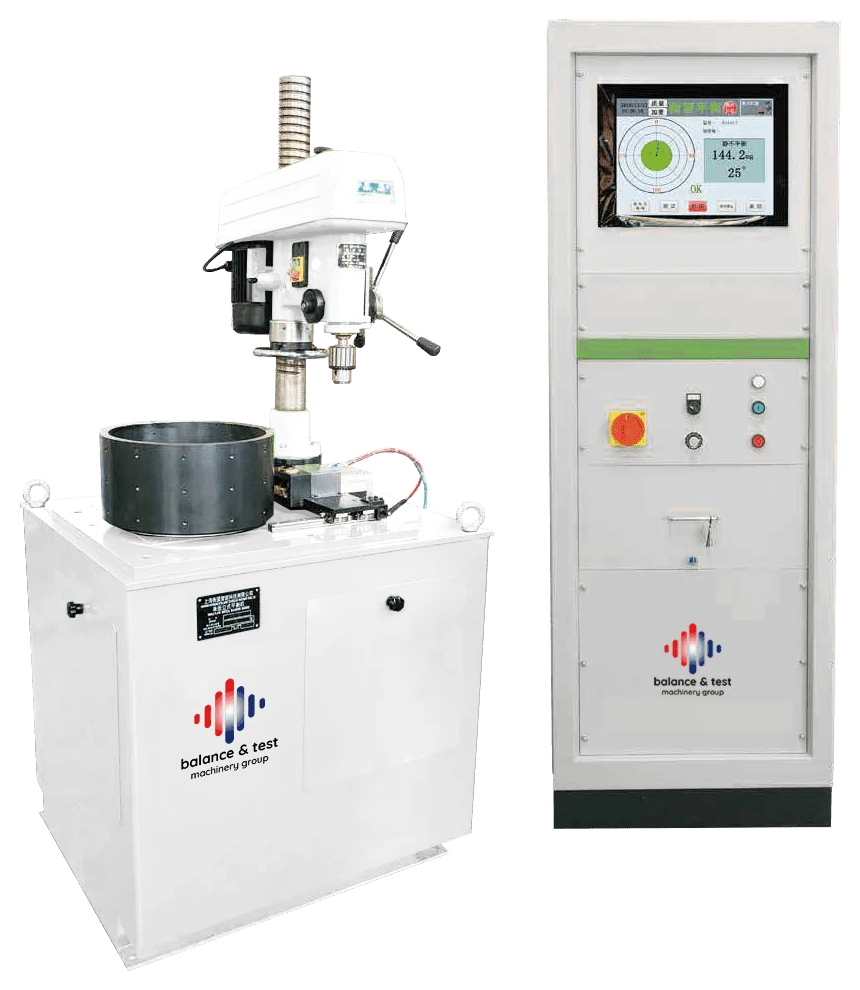
Vertical balancers are for disc-shaped components with a bore or spigot, such as pulleys, clutch plates, brake rotors, fan wheels and impellers. The part is located on tooling on the spindle face, and the spindle, suspension and drive are built into the machine base. Machines measure in one plane or two. The design makes them simple to set up, easy to load and highly repeatable.
Balancing corrections can be configured to suit the application. Machines can be supplied as measure-only systems, or equipped with correction stations for manual drilling, or fully automated setups with integrated drilling, milling, punching, welding, or grinding. This ensures flexibility for both low-volume repair work and high-throughput OEM production.
Levels of automation range from basic measure-only units to manual correction machines and fully automated balancing systems with integrated correction and material handling.
Tooling is supplied to match the component type. Options include solid adapters, manual or automatic collets, and automatic chucks, all engineered for secure workholding and fast changeover between parts.
Applications
Where it works.
Key features
Accurate. Robust. Simple.
Every machine is proved to ISO 21940-21 before it ships.
Engineered for continuous industrial use
Manual and automatic machines available
Industry leading on new machines.
Measuring system
Measure, correct, certify.
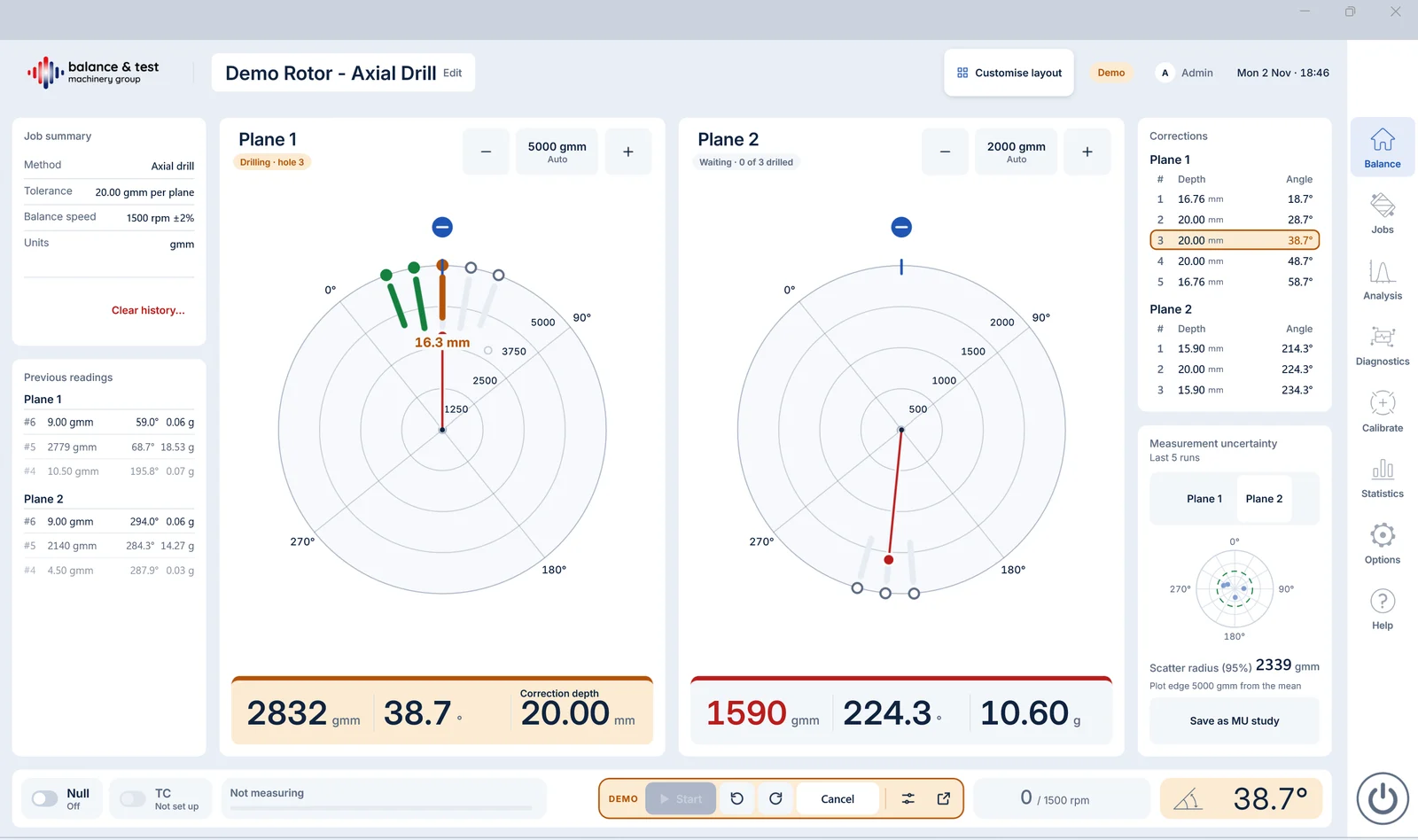
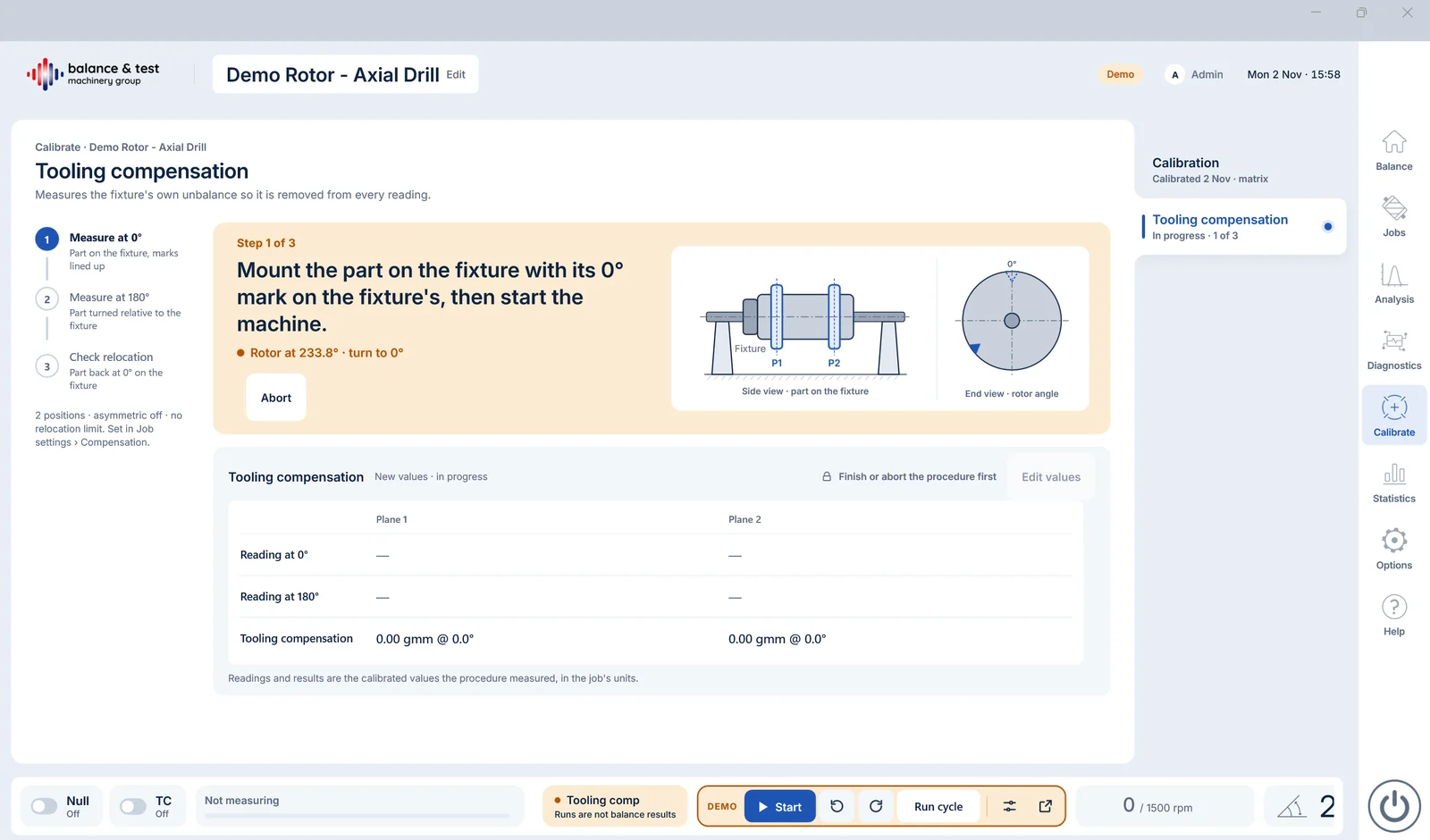
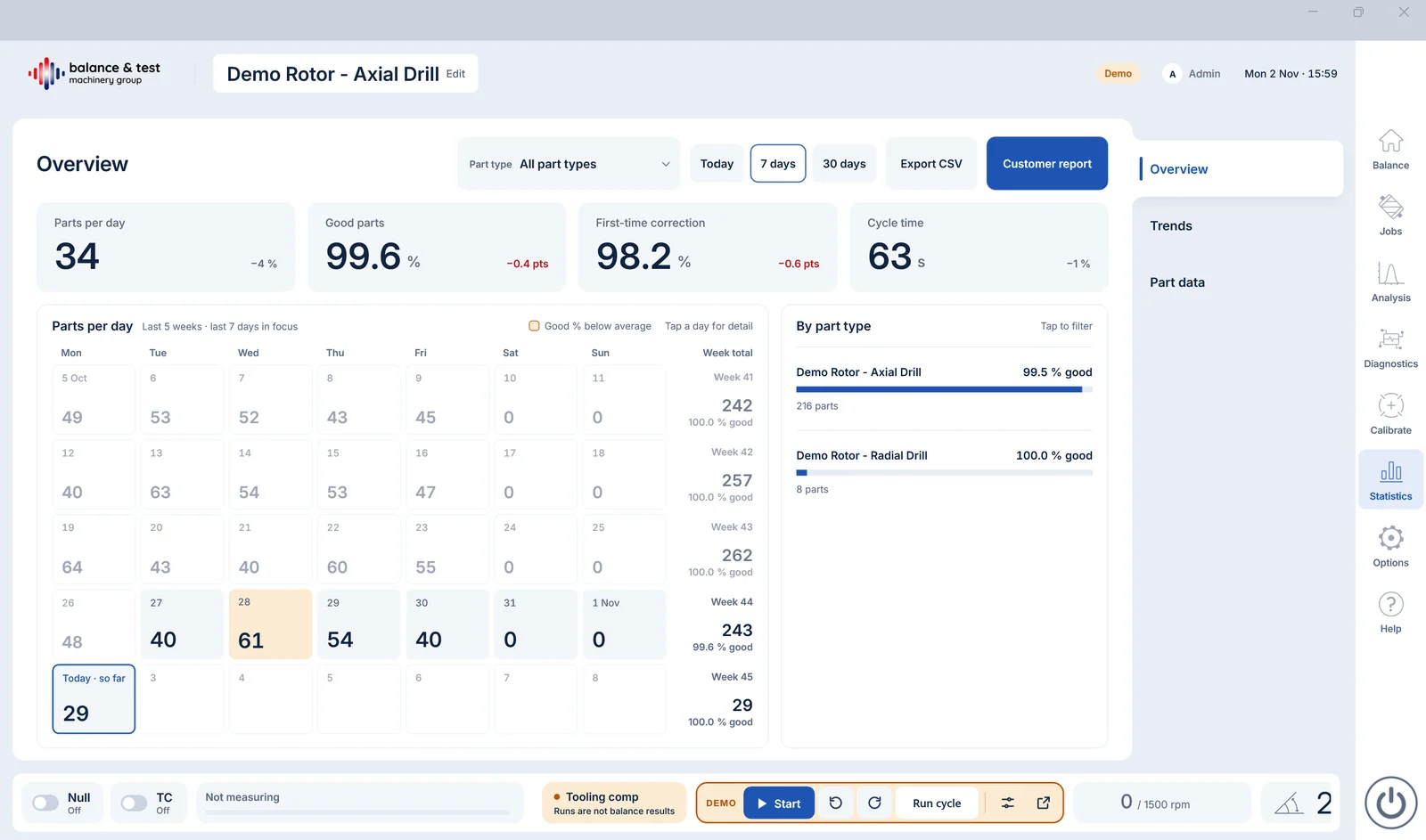
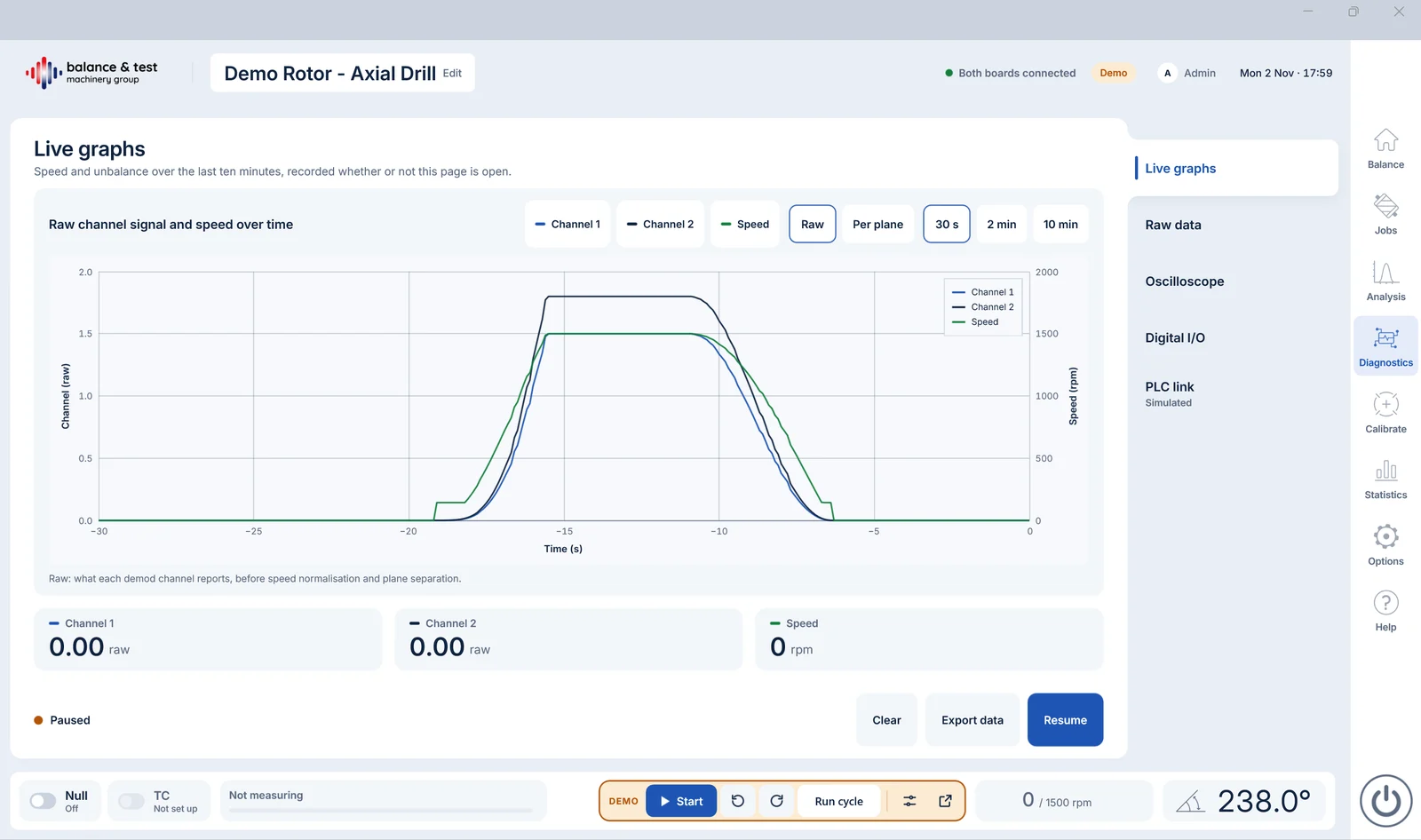
Our fifth-generation measuring system: dedicated electronics that measure unbalance with extreme accuracy, connected over Ethernet to the UltraX balancing software.
01 / 06
Each correction plane has its own polar display, with the unbalance amount, angle and correction in large, easy-to-read figures. During correction, every hole appears with its depth and angle and turns green once drilled.
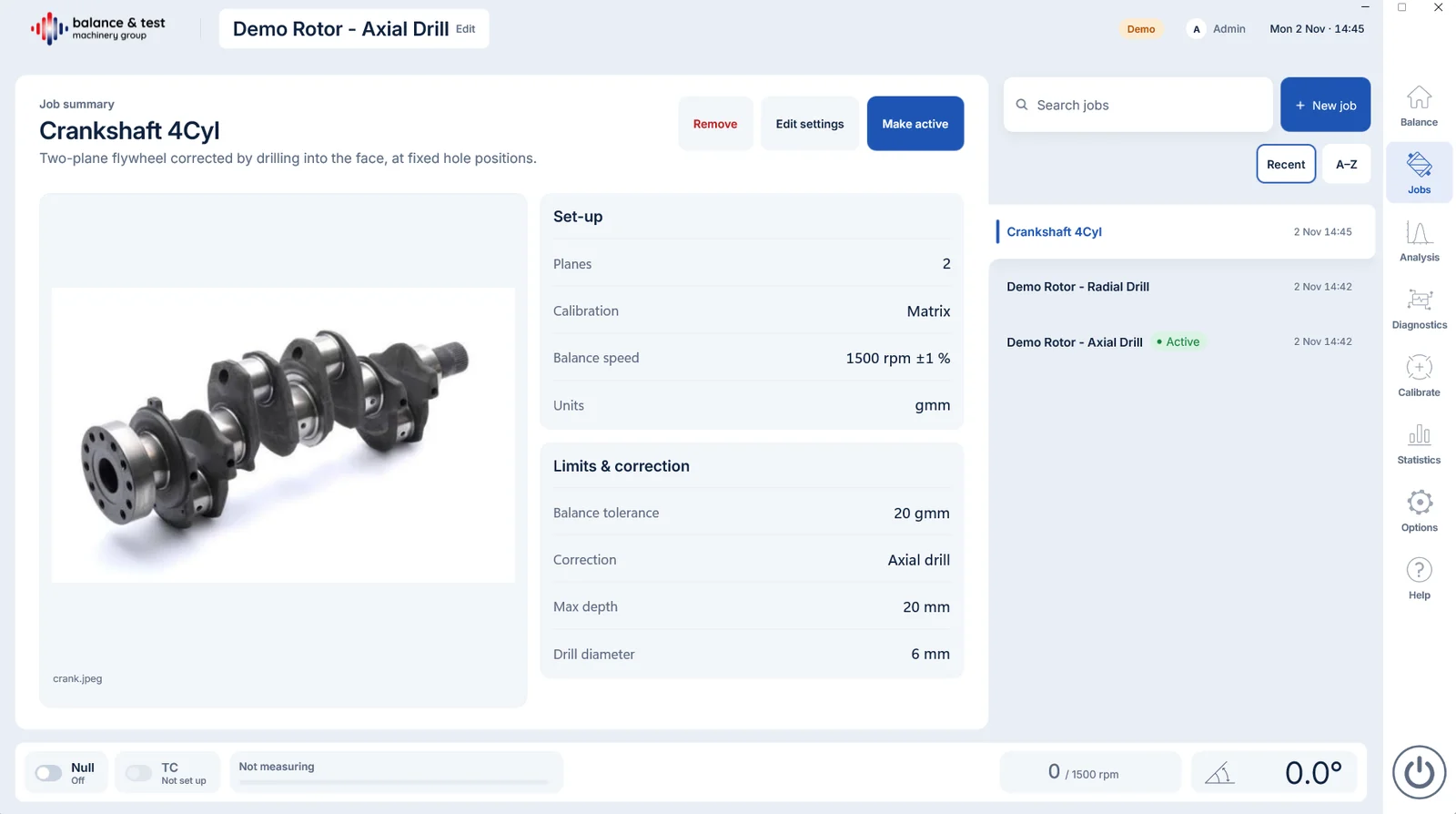
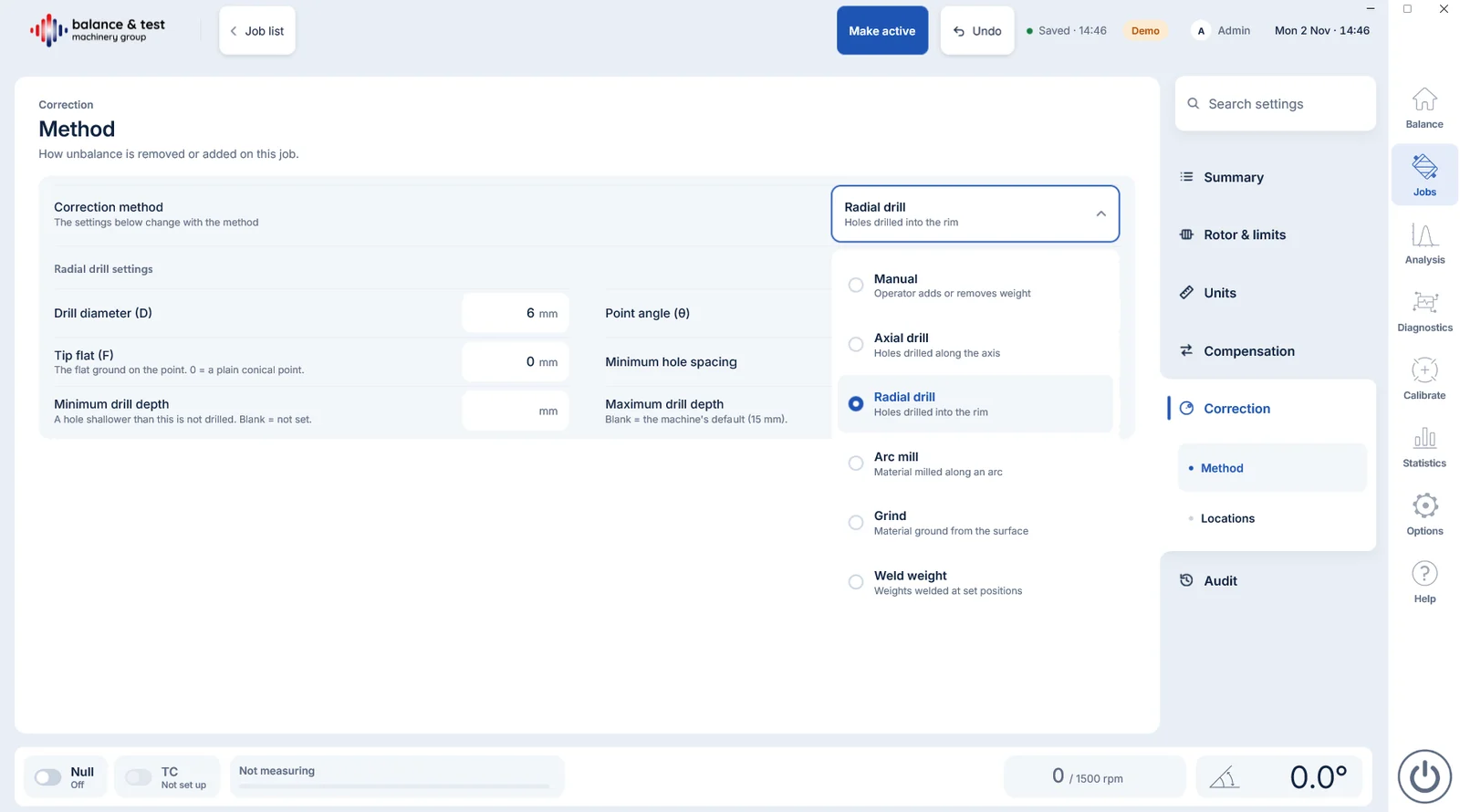
The real UltraX software balancing a demo rotor: measure, drill, re-measure.
Specifications
The numbers.
| Model | V1.5 | V5 | V16 | V42 | V65 | V100 | V200 | V300 |
|---|---|---|---|---|---|---|---|---|
| Maximum rotor weight - including tooling (kg) | 1.5 | 5 | 16 | 42 | 65 | 100 | 200 | 300 |
| Maximum rotor diameter (mm) | 120 | 280 | 500 | 500 | 700 | 1000 | 1200 | 1500 |
| Maximum rotor thickness (mm) | 60 | 70 | 160 | 160 | 200 | 250 | 250 | 250 |
| Minimum achievable residual unbalance gmm/kg | 0.5 | 0.5 | 1 | 1 | 3 | 5 | 5 | 5 |
| URR (%) | 95 | 95 | 95 | 95 | 95 | 95 | 95 | 95 |
| Drive power (kW) | 0.2 | 0.4 | 1.5 | 1.5 | 3 | 3 | 4.5 | 5.5 |
| Balance speed (rpm) — max balance speed presettable | 3000 | 2400 | 1250 | 1250 | 960 | 760 | 760 | 550 |
Scroll sideways for all 8 models
Non-standard specifications available.
Why Balance & Test
Service that delivers.
Industry leading on new machines.
Installation and operator training included as standard.
Plus local service teams.
Head office and service center in Bristol, UK; service and support in Ann Arbor, Michigan; engineering, manufacturing and support in Spain; sales and support in Germany.
Balancing machines and all our equipment are built to CE, UL or CSA standards, to suit your market.
We service and calibrate balancing machines from any manufacturer.
FAQ
All vertical balancers are built to CE, UL or CSA standards to suit your market, and every machine is proved to ISO 21940-21 before shipment.
A vertical balancing machine spins the rotor about a vertical axis on a spindle, with the part located on tooling on the spindle face. It suits disc-type parts with a bore.
Vertical machines are best suited to disc-type components where the width is small compared with the diameter, such as brake rotors, pump impellers, grinding wheels and pulleys.
Vertical machines are very accurate for disc-type rotors. Horizontal machines can reach a finer resolution on shafted rotors, because the journals sit directly on the supports, but for most discs a vertical machine is the more accurate and faster choice, as no mandrel is needed.
Vertical balancing machines offer several benefits. The suspension, spindle and drive are all in the base, so drill chips and debris stay out of the working parts and the machine needs cleaning less often. The spindle face takes simple tooling, or automatic expanding tooling for medium to high volumes. Manual or automatic drilling or milling is easier to add than on a horizontal machine. The footprint is also smaller.
Vertical balancing machines are easy to maintain. Keep the spindle face and tooling clean, check the drive belt condition, and check the spindle bearings periodically for any roughness or knocking.
Very little. Keep at least one spare pickup transducer, one spare pickup lead and a spare encoder. Panel components matter less, as long as the machine maker stocks its own spares.
Ready to balance better?
We’ll configure the right vertical balancing machine for your technical needs and budget.