
Short answer: Static balancing corrects a rotor in one plane and suits thin, disc-shaped parts. Dynamic balancing corrects in two planes and is needed for longer rotors, or any rotor where a "wobble" as well as a "heavy spot" has to be removed.
What unbalance is
A rotor is unbalanced when its mass is not spread evenly around its axis of rotation. As it spins, the uneven mass produces a force that goes round with the shaft. You feel it as vibration, hear it as noise and pay for it in bearings. And it grows with the square of the speed: double the speed and the force is four times larger.
Unbalance is mass multiplied by radius, which is why it is measured in g·mm. Five grams sitting 500 mm from the axis is the same unbalance as 50 g at 50 mm. There are two basic kinds.
Static unbalance
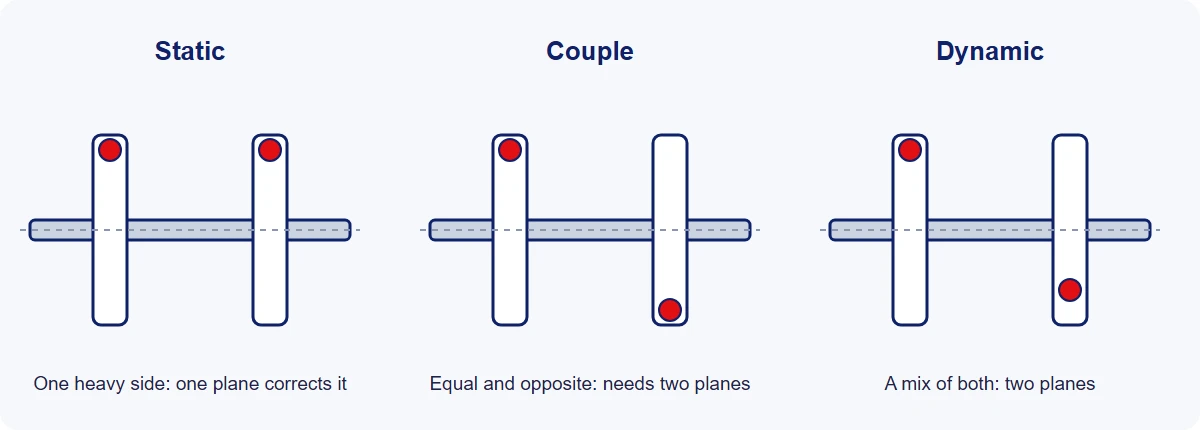
Static unbalance is a single heavy spot. The rotor's center of mass sits off the axis of rotation, but the mass axis is still parallel to it.
- Put the rotor on low-friction knife edges and it rolls until the heavy spot is at the bottom. That is why it's called static: you can find it without spinning the part.
- It is corrected in one plane, by adding or removing weight opposite the heavy spot.
- It is also called single-plane or force unbalance.
Couple unbalance
Couple unbalance is two equal heavy spots at opposite ends of the rotor, 180° apart. The center of mass is on the axis, so the rotor sits still on knife edges and looks balanced. Spin it and the two ends pull in opposite directions, so the rotor rocks end to end.
- It can only be detected with the rotor spinning.
- It can only be corrected with weights in two planes.
Dynamic unbalance
Real rotors nearly always have both at once. That combination is dynamic unbalance: the mass axis is neither on the rotation axis nor parallel to it. Dynamic balancing measures the rotor while it spins and gives a correction, amount and angle, for each of two planes. Correcting both planes removes the static and the couple component together.
Which one does your part need?
The deciding factors are the rotor's shape, its speed and how tight the tolerance is.
| Rotor | Usual method |
|---|---|
| Thin disc, width much smaller than diameter: flywheel, brake disc, grinding wheel, single-stage fan, pulley | Static (one plane) |
| Width similar to or greater than diameter: armature, crankshaft, roll, multi-stage impeller, driveshaft | Dynamic (two planes) |
| Thin disc running at high speed or to a tight tolerance | Dynamic, or static with a check on couple unbalance |
| Thin disc that isn't square to its shaft (axial run-out) | Dynamic, because run-out creates couple unbalance |
Large fans are where people get caught out. Take a 1,200 mm fan of 40 kg. Five grams of weld spatter, or a patch where the coating didn't take, 550 mm out from the axis, is 2,750 g·mm. G 6.3 at 1,500 rpm allows about 1,600 g·mm for the whole rotor. Five grams, about the weight of a sheet of paper, has put you well over tolerance on its own.
A rule used across the pump and fan industry: if the diameter is at least six times the width, one plane is usually enough. Treat it as a starting point, not a guarantee. Speed and tolerance matter too, and a narrow part mounted with run-out can still carry enough couple unbalance to matter. If in doubt, measure in two planes: the machine will soon tell you whether the couple is worth correcting.
Common misunderstandings
- "Static" doesn't always mean the part stands still. A non-rotating machine weighs the part on a pivot and never spins it; many other "static" machines do spin the part and correct in one plane. The word describes the kind of unbalance being corrected, not the machine.
- A statically balanced rotor is not necessarily balanced. It can sit perfectly still on knife edges and still carry a large couple that rocks it as soon as it spins.
- Two-plane balancing doesn't need two machines or two runs. A dynamic machine reports both planes in a single spin.
How the tolerance is set
Whichever method is used, the target is the permissible residual unbalance for the rotor, normally set with a balance quality grade from ISO 21940-11. See ISO 21940 balance grades explained.