
Rule of thumb: A balancing machine is chosen from the rotor outward. Seven facts about your parts decide the machine: shape, size and weight range, tolerance, number of planes, how the part is driven, how unbalance is corrected, and how many you need to balance per shift.
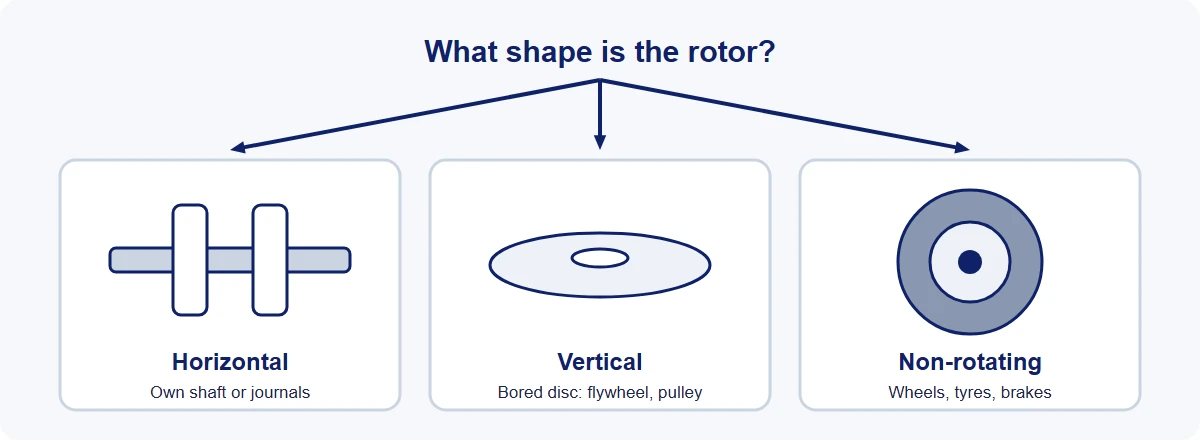
1. What shape is the rotor?
- It has its own shaft or journals (armature, crankshaft, roll): a horizontal machine.
- It's a disc with a bore (flywheel, brake disc, pulley): a vertical machine.
More detail: horizontal vs vertical balancing machines.
2. What is the size and weight range?
List the smallest and largest rotor you expect to balance, not only today's part:
- Weight, lightest and heaviest
- Maximum diameter (the swing over the bed)
- Journal diameters and the distance between them, or bore sizes for disc parts
- Overall length
A machine works best in the middle of its range. Bigger machines carry more weight but lose sensitivity on small, light parts: one sized for a 2,000 kg rotor will not see a 5 kg one well. Choose the capacity on weight. If the problem is diameter, a larger swing (raised supports) on the lighter machine is usually better than jumping to a heavier one. And if your range is very wide, two machines often cost less than one compromise.
3. What tolerance do you have to meet?
The tolerance is normally given as a balance quality grade (for example G 6.3 or G 2.5) at the rotor's service speed, which converts to a permissible residual unbalance in g·mm. See ISO 21940 balance grades explained.
Compare that figure with the machine's minimum achievable residual unbalance. The machine should reach well below your tolerance, so you meet it comfortably and not at the limit of what the machine can see. If the machine is only just good enough, the same rotor will pass on one run and fail on the next.
4. One plane or two?
Thin discs are usually corrected in one plane; longer rotors need two. See static vs dynamic balancing. If in doubt, specify two-plane measurement: it can always report a single-plane result, and the reverse isn't true.
5. How will the rotor be driven?
| Drive | Good for | Watch for |
|---|---|---|
| Belt over the rotor | Smooth cylindrical rotors; highest accuracy, nothing attached to the part | Needs a clean surface for the belt |
| End drive (jointed shaft) | Heavy rotors, rotors with high windage such as fans, parts with no belt surface | The drive shaft adds its own unbalance, which has to be compensated |
| Self-drive | Assembled motors, turbochargers | Speed control |
| Spindle (vertical machines) | Disc parts | Tooling accuracy |
One thing catalogues rarely tell you: large fans need far more drive than the catalogue figure. A 1,200 mm fan wheel pushes a lot of air, and windage and inertia can take two or three times the power a solid rotor of the same weight needs. Check the drive is sized for your largest fan, not just its weight.
6. How will the unbalance be corrected?
- Removing material: drilling, milling, grinding. Common on flywheels, crankshafts, brake discs.
- Adding material: clip-on, welded or adhesive weights, balancing putty. Common on fans, driveshafts, armatures.
Decide whether correction happens on the machine or at a separate station, and whether the operator does it by hand from a screen prompt or the machine does it automatically. Then check one correction does enough. On a stainless flange we quoted, a full-depth 10 mm drill hole at 25 mm radius removed only about 12 g·cm, less than the tolerance itself, so a casting arriving well out of balance would need several holes. If the correction can't cover the incoming unbalance, no machine will fix that.
7. How many per shift?
| Volume | Typical machine |
|---|---|
| Repair shop, one-offs, mixed parts | Manual universal machine, quick changeover |
| Batches of similar parts | Manual load with guided or semi-automatic correction |
| Production line, one part family | Automatic measure, correct and re-check, with automatic loading |
Cycle time is floor-to-floor: load, spin up, measure, stop, correct, check, unload. Ask for it in those terms.
Don't forget
- Safety guarding suited to the rotor and speed, and compliance for your market (CE, UL).
- Data: balance certificates, traceability by serial number, links to your production system.
- Calibration and support: who calibrates it, how often and to what standard. See the calibration guide.
- Tooling: for vertical machines it is a large part of the result and the budget.
What to send a supplier
A short specification gets you a far better quote:
- Drawings or photos of each rotor type
- Weight, diameter, length and journal or bore sizes, smallest to largest
- Service speed and required balance grade or tolerance
- Correction method you use or want
- Quantity per shift and changeover frequency
- Supply voltage, floor space and lifting equipment available