
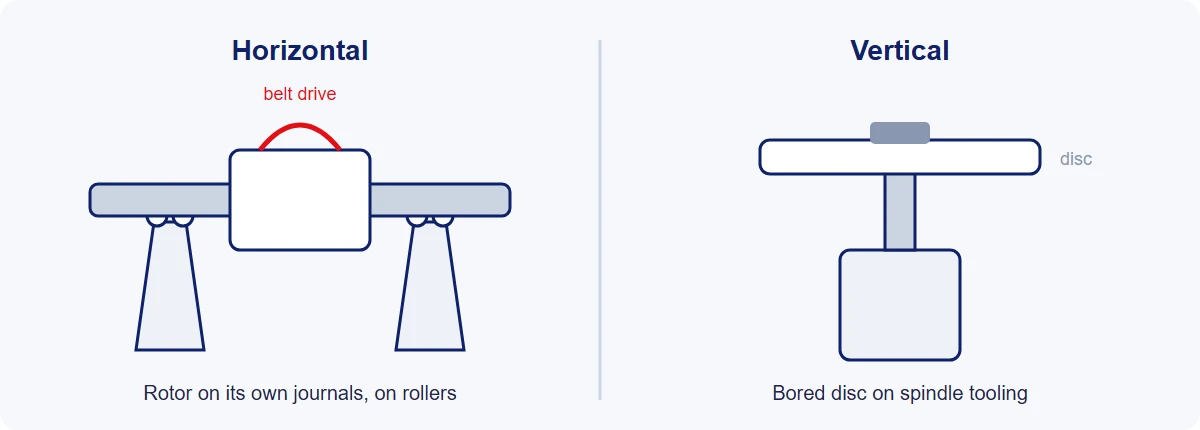
Short answer: The names describe which way the rotor's axis points on the machine. A horizontal machine supports a rotor lying on its side, on its own journals. A vertical machine holds a disc-shaped part flat on an upright spindle. The right choice follows from one question: does the part have its own shaft?
Horizontal balancing machines
The rotor lies on its side and rests on two supports, usually rollers, at its own bearing journals. It is driven either by a belt running over the rotor body or by an end drive: a jointed drive shaft coupled to one end. Belt drive adds nothing to the part, so it is the first choice where there is a clean surface for the belt. End drive is for heavy rotors, fans with high windage and parts with nothing to put a belt on.
Suits: rotors with their own shaft or journals.
- Electric motor armatures and rotors
- Crankshafts and driveshafts
- Rolls, spindles and turbine rotors
- Fans and impellers already mounted on their shaft
Strengths
- The rotor runs on the same journals it will run on in service, so no tooling error is added.
- The supports slide along the bed, so one machine covers a wide range of lengths and weights.
- Two-plane measurement is standard.
Limits
- A part with no shaft needs a balancing arbor made for it, and the arbor's own error has to be dealt with.
- Loading long or heavy rotors needs a crane or lifting gear and floor space along the bed.
Vertical balancing machines
The part sits flat on a spindle that points upward, located by its bore or a register and held by a chuck, collet or fixture. The spindle spins the part.
Suits: disc-shaped parts with no shaft of their own.
- Flywheels, clutches and pressure plates
- Brake discs and drums
- Pulleys, gears and grinding wheels
- Fan wheels and pump impellers before they're fitted to a shaft
Strengths
- Fast to load and unload: the part drops onto the tooling, which also makes automatic loading easy.
- Correction by drilling or milling can be built in at the same station.
- Small footprint.
Limits
- The tooling carries the accuracy. Run-out or looseness in the adapter shows up as unbalance in the part, so tooling has to be made well and checked. A 180° index test (measure, turn the part half a turn on the tooling, measure again) tells you how much is tooling.
- Each bore size or part family may need its own adapter.
Side by side
| Specification | Horizontal | Vertical |
|---|---|---|
| Rotor axis | Lying flat | Upright |
| Part held by | Its own journals, on rollers or bearings | Tooling on the machine spindle |
| Typical parts | Shafts, armatures, crankshafts, rolls | Discs, flywheels, brake discs, pulleys |
| Planes | Usually two | One or two |
| Loading | Lifted onto supports | Dropped onto spindle |
| Main source of error to manage | Drive and journal condition | Tooling run-out |
Does vertical mean static and horizontal mean dynamic?
No. Many vertical machines measure in two planes, and a horizontal machine can be used for a single-plane correction. Orientation is about how the part is held. The number of planes is a separate question, covered in static vs dynamic balancing.
One more distinction: hard-bearing and soft-bearing machines. A hard-bearing machine has stiff supports that barely move, so it measures force and stays calibrated for any rotor within its range; you set the dimensions and run. Most of our machines are hard-bearing. A soft-bearing machine lets the supports move and measures that movement. It is very sensitive but needs a trial run on each new rotor type. Driveshaft machines are usually soft-bearing.
How to decide
- Does the part have its own journals? Yes: horizontal. No: vertical.
- Is it a disc that will later be fitted to a shaft? Balance it on a vertical machine as a component. If the assembly tolerance is tight, balance the finished assembly on a horizontal machine as well.
- What volume? High-volume disc parts favor vertical machines with automatic correction.
- How long and heavy? Long rotors and heavy rotors with journals belong on a horizontal machine.