
How it works: An automatic straightening machine rotates the part between supports, measures its runout at several points along the length, works out where the bend is and how far to press, bends the part slightly past straight so that it springs back true, and then measures again. It repeats until the part is in tolerance or is rejected.
Why shafts bend
Very few shafts are bent by accident. Most distortion is built in by the processes that make the part:
- Heat treatment. Hardening and quenching release and create stresses unevenly, and long slender parts move the most. This is the largest single cause.
- Machining and forming. Turning, milling a keyway, rolling a spline or a thread removes or moves material on one side and lets the stress in the rest of the bar redistribute.
- Welding. A weld shrinks as it cools and pulls the part toward it.
- The raw bar. Bar and tube arrive with some bow and with residual stress from rolling or drawing.
- Handling and storage. Long parts stored badly, or dropped, take a set.
What a bent shaft costs downstream
- Grinding. More stock has to be left on to clean up, so cycle time and wheel wear go up. A part that is too bent will not clean up at all.
- Assembly. Bearings, gears and seals run out of line, which shows up as noise and early wear.
- Balancing. A bent shaft carries its mass off the axis of rotation. Balancing can add weight to compensate at one speed, but it does not make the shaft straight, and on a long shaft the correction needed can be more than the design allows. Straighten first, then balance.
Measuring: runout along the length
The part is held the way it will run, between centers or on rollers at its bearing journals, and turned slowly. Displacement transducers touch it at several stations along its length, from a few on a short shaft to a dozen on a long tube. Each records the total indicated runout: the difference between the highest and lowest reading over one revolution.
Two things come out of each station: how much the surface runs out, and at what angle the high point sits. Put the stations together and the machine has the shape of the bend. A simple bow shows as high points all at the same angle, largest in the middle. An S-shaped bend shows as high points on opposite sides at different stations. More measuring stations give a truer picture of a complicated shape.
Runout is not the same as bend. A journal that is round but off-center, or a surface that is not round, also produces runout. The machine has to separate the once-per-revolution part of the signal, which is the bend, from the rest.
Pressing: three-point bending and springback
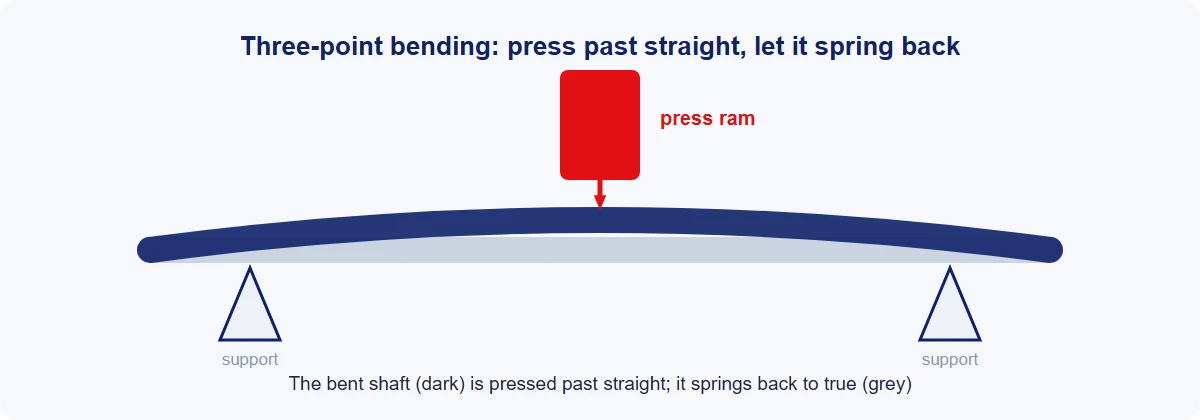
The correction itself is a three-point bend. The part rests on two supports, often called anvils, with the high point facing the ram. The ram presses down between them.
Steel is elastic up to its yield point. Press a shaft a small amount and let go, and it returns to where it started. To change its shape permanently, the ram has to push the material past yield, so that part of the deflection stays when the load comes off. The rest springs back.
So the machine never presses a shaft to straight. It presses it beyond straight by a calculated amount and relies on springback to bring it to true. How far beyond depends on the diameter, the distance between the supports, the material and its hardness. Two shafts from the same drawing but different heat-treatment batches can need different strokes.
This is why the control matters more than the press. Our machines run closed-loop on both force and stroke: they calculate the stroke from the measured bend, press, measure the result, and adjust for the next stroke. Two shafts from different heat-treatment batches can need different strokes, and the machine finds that out as it goes.
The automatic cycle
- Load. The part is placed between centers or on rollers, by hand, by gantry or by robot.
- Measure. The part rotates and runout is recorded at every station.
- Decide. If every station is within tolerance, the part passes without being pressed.
- Position. The part is turned so the high point faces the ram, and the supports and ram move to the right place along the length.
- Press. The ram makes the calculated stroke and retracts.
- Re-measure. The part rotates again and the new runout is compared with the tolerance.
- Repeat or finish. The machine presses again, at the same place or another, until the part is in tolerance. If it reaches a set number of strokes without success, it rejects the part.
Cycle time depends mostly on how many strokes a part needs. That in turn depends on how bent the parts arrive, how tight the tolerance is, and how many stations have to be brought in at once. A shaft with several bearing journals and a tight tolerance on each takes longer than a plain bar.
What limits the result
Geometry. Short, stiff sections are hard to bend without marking them. Changes of diameter, splines and threads limit where the supports and ram can touch. Hollow parts can be dented or ovalized if the contact is too narrow.
Hardness. Soft and through-hardened parts yield predictably. Case-hardened and induction-hardened parts have a hard, brittle skin over a softer core, and the skin can crack before the core has yielded enough. For these the stroke is limited and the correction made in small steps.
Residual stress. Press straightening does not remove the stress that bent the part. It adds an opposing one. If material is removed afterward, or the part is heated, some of the bend can return. This is why straightening is normally done after heat treatment and before finish grinding, and why the straightening tolerance is set to leave the grinder enough to work with.
Measurement. A machine cannot straighten closer than it can measure. Worn centers, dirty journals and out-of-round surfaces all appear as runout.
As an example of what is achievable: a long-bed machine configured for 8 m oilfield tubulars works to a runout acceptance of 0.5 mm per metre. Short precision shafts are held much tighter; send the drawing and we will tell you what your part can achieve.
Manual, semi-automatic or automatic?
- Manual. An operator reads a dial gauge, judges the stroke and presses. The result depends on skill, and experienced straighteners are hard to find. Suits small quantities and wide variety.
- Semi-automatic. The machine measures and tells the operator where and how far to press, or presses under the operator's control. Removes most of the judgment.
- Automatic. The machine measures, calculates, presses and re-measures on its own, and records the result for each part. Suits volume production and anywhere a traceable record is needed.
Press straightening is not the only method
- Roll (rotary) straightening passes plain bar or tube between angled rolls. It is fast and suits long, uniform stock, but it cannot be used on a part with shoulders, splines or journals.
- Heat straightening uses local heating to pull large fabrications and very heavy shafts straight. It is a skilled manual process.
For finished or part-finished shafts with features, press straightening is the usual choice.
Where straightening sits in the line
A common order for a hardened shaft is: rough machine, heat treat, straighten, finish grind, balance if the part needs it, then final inspection. For welded assemblies such as driveshafts, the tube and the finished assembly are checked for runout before balancing, because runout left in shows up as unbalance that changes with speed.
Balance & Test straightening machines use PLC-based control for measurement and correction, and can be configured for manual loading, semi-automatic operation or fully automated production.